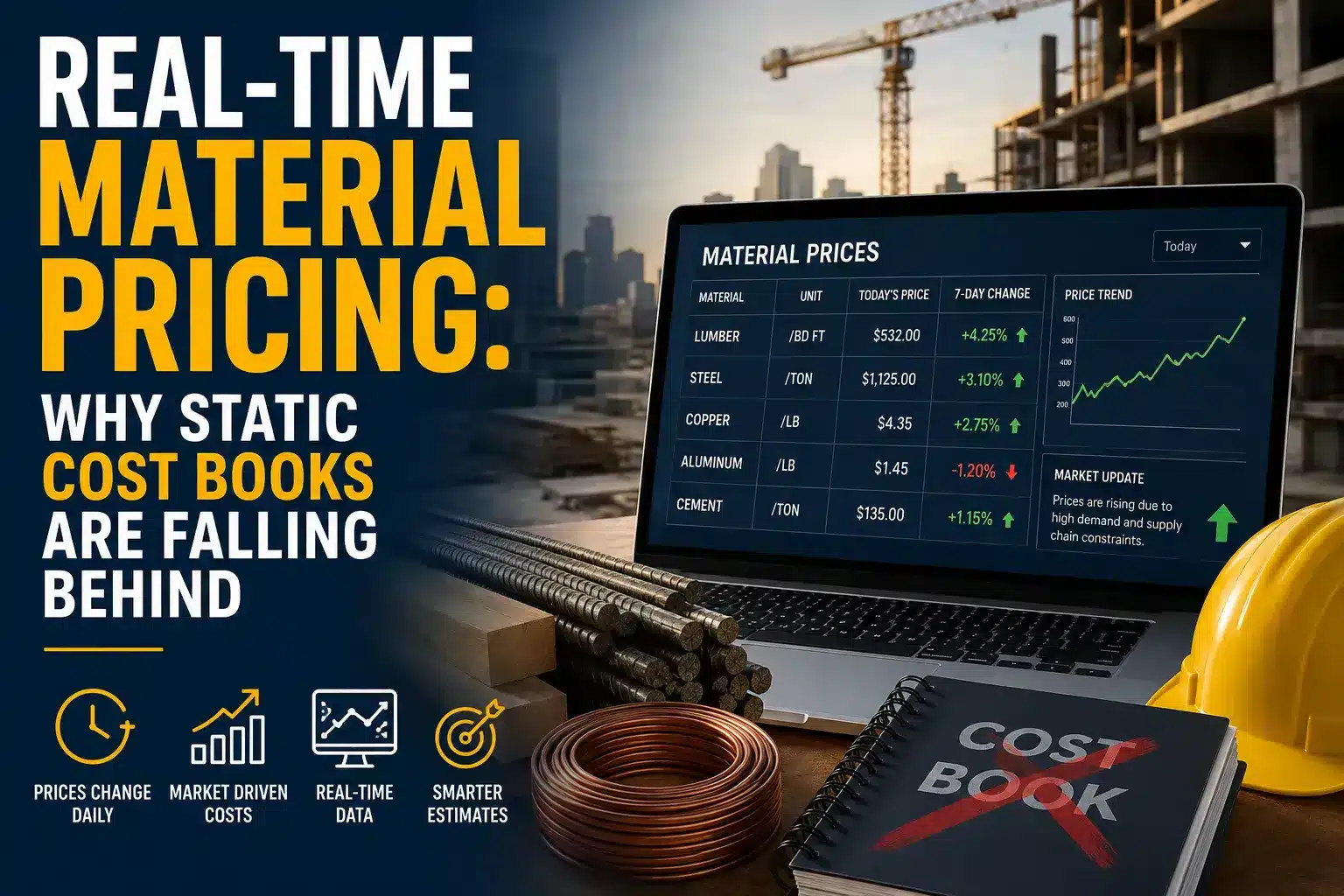
Static cost books like RSMeans and regional price guides are built on quarterly or annual updates. Material prices, especially lumber, steel, copper, and PVC, can change in a matter of weeks. In 2026, real-time pricing tools are closing that gap. Estimators who are still preparing bids from a printed book are often working with outdated numbers. The estimating teams that are getting this right are not entirely eliminating the use of cost books. They use them as a baseline, using current prices for anything that changes a lot or is affected by time.
DON’T LET A STALE COST BOOK EAT YOUR MARGIN. BUILD YOUR BIDS ON CURRENT MATERIAL PRICING AND REAL SUPPLIER DATA.
What “Real-Time Pricing” Actually Means Right Now
Static cost books
RSMeans and similar publications are considered the base for labor rates and stable, low-volatility materials. They’re still the right tool for a huge share of a typical estimate.
Distributor and supplier price feeds
Some estimating platforms now extract live pricing through API from supplier catalogs. It helps to get an actual current quote.
Market index and commodity tracking tools
Some services track commodity indexes:
- Lumber futures
- Steel scrap indexes
- Copper spot prices
They turn the price data into useful estimating updates. This is helpful when the material’s price is changing, so you get a new price before submitting a bid.
AI-aggregated pricing tools
The latest platforms use AI to extract pricing from multiple distributors and historical data. This gives a current estimate faster than the manual finding process.
However, the main part is to know which layer you are using because a market index tells you a trend is happening.
Why This Is A Growing Concern
For decades, a cost book was simply the industry standard. Historical databases and RSMeans provided a consistent number to build a bid. However, everyone accepted that those numbers were a snapshot, not a live price. This worked fine when the material prices were stable. But this does not work fine in the market where a single tariff announcement or a supply chain issue doubles the figure.
According to Producer Price Index data for softwood lumber, tracked by the U.S. Bureau of Labor Statistics and published via the Federal Reserve Bank of St. Louis:
The index rose roughly 8% between December 2025 and February 2026 alone. This change shows that book-based estimates are never reliable.
What A Cost-Book-Based Estimate Actually Involves
Experienced construction estimating companies just use it as a starting point, then apply local knowledge on top:
- Adjusting the book’s national or regional average for local supplier relationships and current lead times
- Knowing which line items in a given book are chronically stale versus reliably accurate
- Applying escalation factors for materials likely to move before the project actually breaks ground
- Cross-checking volatile materials against a recent quote rather than trusting the book number outright
Static Cost Books Vs. Real-Time Pricing: The Direct Comparison
|
Factor |
Static Cost Books |
Real-Time / Live Pricing Tools |
|
Update frequency |
Quarterly to annual | Daily to real-time |
|
Best for |
Labor rates, stable materials, national benchmarking | Volatile materials (lumber, steel, copper, PVC) |
|
Consistency across bids |
High — same number every time |
Can shift bid-to-bid if not locked at proposal time |
| Local accuracy | Requires manual adjustment for region and supplier |
Often reflects local distributor pricing directly |
|
Defensibility with a client |
Familiar, industry-standard reference | Newer, sometimes needs explaining to a client or GC |
| Risk during price spikes | High — the book may already be outdated |
Lower — closer to current market reality |
| Setup and cost | Included in most estimating software |
Often, a separate subscription or API integration |
What Most Teams Are Missing: The Internal Price Log
Rather than choosing between “the book” and “a live feed,” a growing number of estimating teams are building a third resource:
An internal price history that is firm-specific.
They extract those prices from their own recent orders and supplier quotes. This has two advantages that neither a public book nor a generic live-pricing tool can offer:
- It reflects your actual negotiated pricing and supplier relationships
- It builds a trend line specific to your market and your suppliers, so you can tell if a price change is happening across the whole market.
This internal log becomes the quickest way to double-check the prices. Before trusting a price book or an outside live price feed, an estimator can simply ask: “What did we actually pay for this three months ago?”
Conclusion
Static cost books are still the right tool for the bulk of a typical estimate. But the risks are associated with the volatile materials and long-lead-time jobs. Because a book number that was accurate at publication can be meaningfully wrong by the time a bid is priced. Do not consider every line item stable because that is exactly where that gap turns into a margin problem on the job.