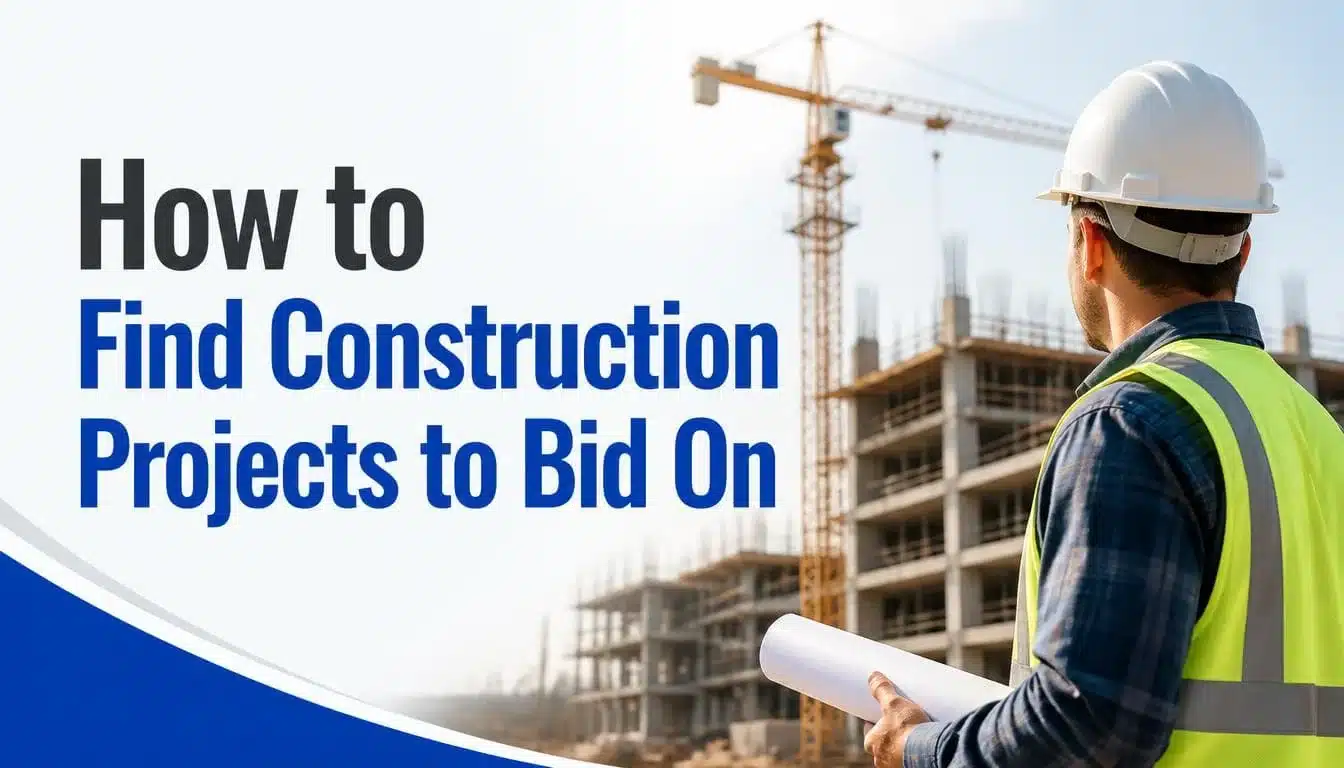
You find construction projects to bid on in four places: free government portals like SAM.gov and state procurement sites and paid plan rooms like Dodge and ConstructConnect. You can also find projects on general contractor bid lists you join by getting prequalified and public planning records such as building permits, zoning agendas, and capital improvement plans. That last group shows you work 12 to 18 months before it hits a bid board.
Found a project but no time to price it? A construction estimating company handles takeoff and pricing so you bid on time.
Where Do Contractors Actually Find Construction Projects to Bid On?
Contractors find work through four channels, and each one reaches you at a different stage of the project’s life. Using only one channel is the single biggest reason a backlog gets empty.
| Channel | When you hear about the job | Cost | Competition |
| Public planning records (permits, CIPs, zoning) | 6–24 months before bid | Free | Almost none |
| Government bid portals (SAM.gov, state, county) | 2–8 weeks before bid | Free | High |
| Paid plan rooms and project databases | 4–12 weeks before bid | $50–$500+/month | Medium |
| GC bid lists and invitations to bid | 2–4 weeks before bid | Free, but you must prequalify | Low to medium |
The pattern is simple. The earlier you hear about a job, the fewer people you compete against. A project posted publicly on a Tuesday is already a commodity. A project you learned about at a planning commission meeting last spring is a relationship.
There is a real market behind this. Total U.S. construction spending ran at a seasonally adjusted annual rate of $2.17 trillion in June 2026, down 3.2% from a year earlier. Public construction held steady at $544.1 billion, per the U.S. Census Bureau’s Construction Spending release. That is the point: when private work softens, public work keeps moving, because it is money that has to be spent and by law most of it has to be advertised.
What Are the Best Free Places to Find Construction Bids?
The best free sources are government procurement portals, which post every publicly funded job by law. You never pay a subscription to see them, and small contractors win on them every week.
Start here:
- SAM.gov: Every federal solicitation over the micro-purchase threshold. Free account, NAICS filters, saved searches with email alerts.
- Your state’s procurement site: Search “[your state] department of administration bids” or “[state] DOT bid letting.” Highway work alone ran at a $150.9 billion annual rate in June 2026, according to Census Bureau.
- County and city purchasing pages: School districts, water districts, parks departments, and transit authorities. These are the least crowded public bids in most markets.
- Public school and university systems: Bond-funded work runs on a published schedule. Educational construction was at a $113.1 billion annual rate in the same Census release.
- SBA SubNet: Prime contractors post subcontracting opportunities they are required to fill with small businesses.
- USAspending.gov: It shows you who won what, for how much, from which agency. Use it to find your competition and your future teaming partners.
- GC websites: Most mid-size and large general contractors run a “Subcontractors” or “Bidding Opportunities” page with live projects.
One habit separates people who get value from free sources and people who give up: alerts. Set a saved search on every portal and let the jobs come to you.
Knowing how to find construction bids is only half the job. The other half is not doing it by hand. Checking a dozen websites every Monday is what most contractors try first. It is too much work, and they quit after three weeks. Alerts do the same job while you sleep.
Which Paid Construction Bidding Sites Are Worth Paying For?
Paid sites are worth it when they give you project data you cannot get free, not when they resell public bids. That is the whole test.
| Platform | Best for | Free option | Pricing |
| Dodge Construction Network | Early-stage and planning-phase projects | No | Quote-based |
| ConstructConnect | Broad commercial database, researcher-verified | Free Bid Center for subs receiving ITBs | Tiered, quote-based |
| BuildingConnected (Autodesk) | Receiving ITBs from large GCs | Free for subcontractors | Paid for GC bid management |
| PlanHub | Small and mid-size GCs, private commercial | Free tier available | Paid upgrades |
| BidClerk / ConstructionWire | Commercial and private projects with detailed reports | Demo only | Quote-based, contact sales |
| BidNet Direct | State and local government bids, aggregated | Limited free access to member agencies | Paid for full region access |
Two things to know before you spend money.
First, several of these platforms hide pricing behind a sales call. Ask for the per-county or per-metro rate, not the national package. Most small contractors are sold territory coverage they will never drive to.
Second, subcontractors should not pay to receive invitations to bid. ConstructConnect’s Bid Center and BuildingConnected are both free on the receiving side. Pay only when you want to search the database yourself and see projects before an invitation arrives.
How Do You Find Projects Before They Go Out to Bid?
You find projects early by reading the paperwork that has to exist before construction starts: building permits, planning and zoning agendas, capital improvement plans, and bond referendums. All of it is public. Almost none of it is on a bid board.
The Dodge Momentum Index reached 291.7 in July 2026, up 6.9% in a single month, and Dodge notes the index leads nonresidential construction spending by a full year to 18 months.
That lead time means that the projects that will be bid in late 2027 already exist on paper right now. Here is where that paper sits.
Building Permit Records
Your city or county issues permits before work starts. Most publish a searchable database or a weekly list. A permit tells you the address, the owner, the estimated value, and usually the general contractor. For subs, that last field is a live prospect list.
Planning and Zoning Commission Agendas
Agendas and minutes are posted online, usually a week before the meeting. A site plan approval in March means bid documents in the fall. Read the agenda packet, not just the agenda.
Capital Improvement Plans (CIPs)
Every city, county, school district, and utility publishes a rolling 5-year CIP with project names, budgets, and target years. Search “[city name] capital improvement plan PDF.” This document is the most underused free lead source in construction.
Bond Referendums and Ballot Measures
When a school district passes a $200 million bond, that money turns into packaged bid opportunities over the next three to five years. Local news covers the vote. Almost no contractor follows up eighteen months later.
Architects and Civil Engineers
Design firms know about a project a year before a GC does. One coffee a month with a local civil engineer beats a $400 subscription for most small contractors.
Working this list changes the job. You stop treating construction projects to bid on as a search problem and start treating them as a calendar problem.
How Do You Get on a General Contractor’s Bid List?
You get on a GC’s bid list by completing their prequalification form and then answering every invitation, including the ones you decline. Prequalification is a document exercise, not a relationship exercise, and most subs overcomplicate it.
Nearly every mid-size and large GC has a prequalification form on their website. Have this ready before you start:
- Contractor’s license and any trade certifications
- Certificate of insurance with current limits
- Bonding capacity letter from your surety (single job and aggregate)
- EMR (experience modification rate) for the last three years
- Financial statement, often reviewed or audited
- Five to ten completed projects with values, dates, and owner contacts
- Safety program summary and OSHA 300 logs
- W-9 and any small business or DBE certifications
After you are on the list, one habit protects your spot. Answer every ITB within 24 hours, even when the answer is no. A fast decline helps the estimator fill coverage and keeps you in good standing. Silence gets you quietly dropped from the next package.
Distance matters more than most subs assume. A Downtobid bid coverage study of 60,000 live subcontractor bids found 80% of jobs sit within 55 miles of the subcontractor’s office and that the top reasons subs decline an invitation are resource constraints (27%) and scope mismatch (26%). If you are chasing work 200 miles out, you are fighting the shape of the whole industry.
How Do You Know Which Projects Are Worth Bidding On?
Score every project before you estimate it. A bid you should not have submitted costs real money, and the bill shows up as estimator hours you cannot bill to anyone.
Run this scorecard. Score each line 0, 1, or 2. Bid at 14 or higher. Walk away below 10.
| Factor | 0 points | 1 point | 2 points |
| Distance from your office | Over 150 miles | 55–150 miles | Under 55 miles |
| Scope match to your crews | Mostly unfamiliar | Partial match | Core work you do weekly |
| Owner or GC history | Never worked with them | Know them, no history | Repeat client |
| Bonding and insurance fit | Exceeds your capacity | Near your limit | Comfortable |
| Schedule vs. your backlog | Direct conflict | Tight | Clean fit |
| Bidder count expected | 10+ | 5–9 | Under 5 |
| Documents complete | Missing specs, no addenda log | Some gaps | Full, coordinated set |
| Payment terms and retainage | 60+ days, 10% retainage | 45 days | 30 days, reducing retainage |
Accurate construction cost estimation depends on scoring these things first, because a perfect price on the wrong job still loses money. The scorecard is not about being picky. It is about pointing your best hours at the jobs you can actually win.
What Does Chasing the Wrong Bid Actually Cost?
According to the Bureau of Labor Statistics May 2025 Occupational Employment and Wage Statistics (OEWS) survey data, cost estimators earn a mean hourly wage of $41.64 (representing a mean annual wage of $86,610).
Bid four wrong jobs a month and you have burned over $8,000 in labor with nothing to show. That is the math that makes a bid/no-bid scorecard pay for itself in the first quarter.
How Many Bids Do You Need to Win One Project?
Plan on 4 to 5 bids per win on private work and 7 to 11 on public work. Those ranges come from the delivery method, not from how good your pricing is.
| Work type | Typical bid-hit ratio | Win rate |
| Negotiated / repeat client | 3:1 to 4:1 | 25–35% |
| Private competitive bid | 4:1 to 5:1 | 20–25% |
| Public hard bid | 7:1 to 11:1 | 9–14% |
Research supports the higher end for firms that pursue selectively. The SMPS Foundation’s “Measuring for Success” report, based on a survey of 303 U.S. architecture, engineering, and construction firms, found an average hit rate of 37.9% across all work types for construction firms, which sits well above the public hard-bid range because it blends in negotiated and repeat work. Firms hitting those numbers are not bidding everything. They are bidding narrowly.
Two practical rules come out of this:
- Track your ratio by category, not overall: One blended number tells you nothing. Split it by public vs. private, by trade, by owner, and by project size. That is where the pattern shows up.
- A ratio that is too low is also a warning: Winning 60% of hard bids usually means you are the cheapest by a wide margin. Check your last three jobs’ actual costs against the estimate before you celebrate.
The Bottom Line
The contractors who consistently find construction projects to bid on are not searching harder. They are reading earlier, filtering tighter, and answering faster. Pull from all four channels, score every job before your estimator opens the plans, track your win rate by category, and protect three hours a week for pipeline work. Do that for two quarters, and the problem stops being where to find work. It becomes which work to take.
Frequently Asked Questions
Q1: What is a good bid-hit ratio in construction?
A healthy ratio is 4:1 to 5:1 on private competitive work and 7:1 to 11:1 on public hard bids. Negotiated and repeat-client work should run better, near 3:1 or 4:1. Track it separately by project type, because blending public and private bids into one number hides the pattern you need. Winning too often can signal underpricing.
Q2: Do I need to pay for a bidding site to get construction work?
No. Subcontractors receive invitations to bid free on ConstructConnect's Bid Center and BuildingConnected, and all public bids are free by law. Paid platforms earn their fee only when they show you planning-stage and private projects you cannot see elsewhere. Buy coverage for your actual service territory, not a national package.
Q3: How do I get invited to bid by general contractors?
Complete each GC's prequalification form with your license, insurance certificate, bonding letter, three-year EMR, financial statement, and a list of completed projects. Focus on the ten busiest GCs within 55 miles of your office. Then respond to every invitation within 24 hours, including declines. Fast, reliable responses keep you on the next bid package.
Q4: How do you follow up on a construction bid?
Call or email two to three business days after the bid date. Keep it short. Confirm they received your bid, ask if any scope needs clarifying, and ask when they plan to award. After that, follow up once a week, and no more. If you lose, ask what the winning number was and why. That answer sharpens your next bid.
Q5: What is the best bidding software for construction?
There is no single best one, because it depends on your role. Subcontractors should use BuildingConnected and ConstructConnect's Bid Center since both are free to receive invitations. General contractors building bid packages get more from PlanHub or SmartBid. For planning-stage projects before they go public, Dodge Construction Network has the deepest database.