
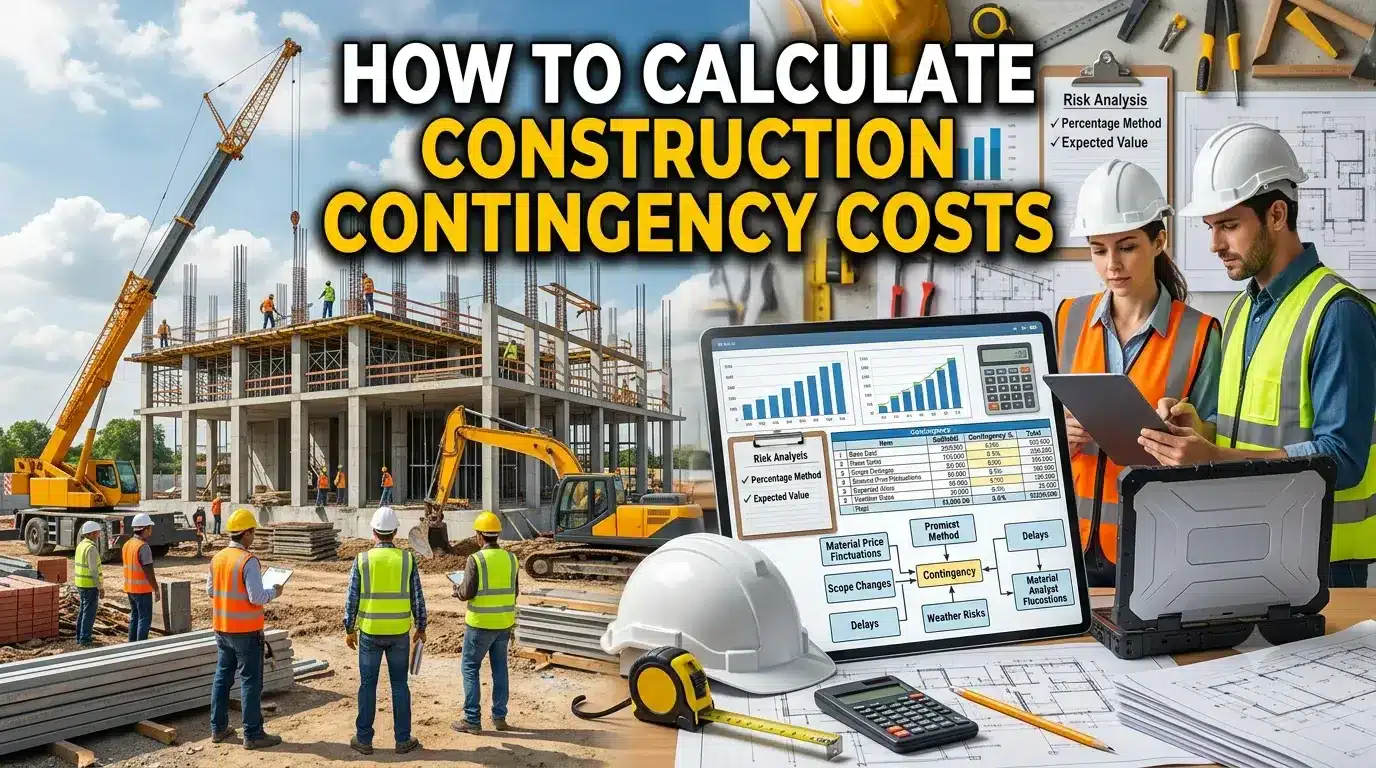
Every construction project almost faces unpredictable challenges. The prices of materials fluctuate and hidden site conditions disturb the whole project budget. Even a small design change in the middle of the project creates so much chaos. This emphasizes contractors to Calculate Construction Contingency Costs accurately before starting the construction work. Without setting an extra budget from the start, such surprises can derail timelines and compromise quality. This extra cost is your construction contingency fund.
All the cost projections are totally dependent on the accurate measurements and counting of the required materials. Most busy contractors have started relying on external Accurate Material Takeoff Services to prevent over-budgeting and delays. If you want to understand how to calculate contingencies, then you need to get hands-on proven methods and know how to manage them accurately through this guide.
Do not let unexpected project expenses derail your budget so learn the right formulas to calculate construction contingency funds
Construction Contingency Explained
Construction contingency is an extra amount reserved that is set aside to cover unexpected costs during the project. This cost is not included in the original estimate.
It acts as a financial safety net that protects your project quality and overall budget when something unexpected happens.
Some people get confused. They need to understand that construction contingency is not:
- A slush fund for poor planning
- A replacement for accurate estimating
- The same as project management fees or overhead
- A guarantee against all cost overruns
Construction contingency is important because:
- A calculated risk reserve tied to real project uncertainties
- A tool for maintaining project quality under pressure
- A signal of professional risk management to lenders and stakeholders
- An evolving budget line that reduces as the project matures
Types of Construction Contingency
1. Design Contingency
Design contingency is used during the early phases of a project when construction documents are incomplete. It considers design changes, material selections, etc.
2. Construction Contingency (Owner and Contractor)
Once construction begins, there are two types of contingency:
- Owner Contingency is controlled by the project owner. It is used for unforeseen site conditions and other risks outside the contractor’s control.
- Contractor Contingency is held by the general contractor. It is used to cover risks within the contractor’s scope.
How to Calculate Construction Contingency
Step 1: Establish Your Base Cost Estimate
You need a precise base cost estimate before starting the calculation. This includes:
- Hard costs
- Labor
- Materials
- Equipment
- subcontractor fees
- Soft costs
- Permits
- design fees
- Inspections
- Insurance
- project management
- Site costs
- Earthwork
- Utilities
- civil improvements
Keep in mind that the accuracy of your base estimate directly affects the reliability of your contingency calculation.
It is important to use quantity takeoffs according to the current material and labor pricing data. The Best Estimating Company assign a “Confidence Grade” to each line item. The purpose is to look at the area that carries the most risk.
Step 2: Assess Project Risk Level
Building owners must understand that every project carries a different risk profile. Various risk factors that increase your contingency percentage include:
- Project type
- Site conditions
- Design completion
- Market conditions
- Project complexity
- Location
- Contract type
Step 3: Apply the Right Calculation Method
Method 1: The Deterministic Method
This method calculates contingency as a fixed percentage of the total base cost estimate. The formula is:
Contingency Budget = Total Estimated Project Cost × Contingency Percentage
The Standard contingency percentages by project type:
| Project Type | Standard Contingency Percentage |
| New construction (low complexity) | 3–5% |
| New construction (standard) | 5–10% |
| Renovation or remodel | 10–20% |
| Historic restoration | 15–25% |
| High-risk builds | 15–25% |
| Civil works | 10–15% |
Method 2: The Probabilistic Method
This method delivers more defensible estimates. It is better to use for large and complex projects. This is how you can apply this method:
- Identify all potential risk events
- Assign a probability of occurrence to each risk
- Estimate the cost impact if the risk materializes
- Multiply probability × impact to get the expected monetary value
Applying Percentages Across the Project Lifecycle
The professional approach to calculate construction contingency is to apply different percentages at different project phases. This approach includes:
| Project Phase | Standard Contingency Percentage |
| Conceptual Phase | 20–25% |
| Schematic Design Phase | 15–20% |
| Design Development Phase | 10–15% |
| Construction Documents Phase | 5–10% |
| Construction Phase | 3–5% |
Best Practices for Managing Construction Contingency
Calculating the right contingency amount is just one single step of the overall process. It is important to manage it correctly throughout the project. You need to apply these best tips:
- Define in the contract who can authorize the use of contingency funds. Be clear about the required approval process. All parties should agree on terms before construction begins.
- Review contingency drawdowns at every project meeting. A contingency log should record each use:
- Date
- Reason
- Amount
- balance remaining
- Contingency should not be used to absorb costs that result from poor planning. It should be captured in a formal change order.
- Cost underruns in one phase can offset overruns in another. When the project is finished, the unused contingency should be returned to the owner.
- Modern construction estimating tools help provide reliable base costs. They also help contractors to generate contingency recommendations based on historical benchmarks.
- As design progresses, formally reduce the contingency to reflect the improved level of certainty. This keeps the budget defensible.
Conclusion
To calculate construction contingency costs, you have to be confident in making the right decisions. It protects everyone involved in the project. However, the right contingency percentage depends on the project type and current market conditions. The present material price unpredictability demands the contingency price to be more accurate then ever. It is recommended to use the right formulas and combine them with fair judgments. Get access to historical data to make the right decisions and not repeat past mistakes. If you outsource this task to a reliable company, then it will protect your budget.