
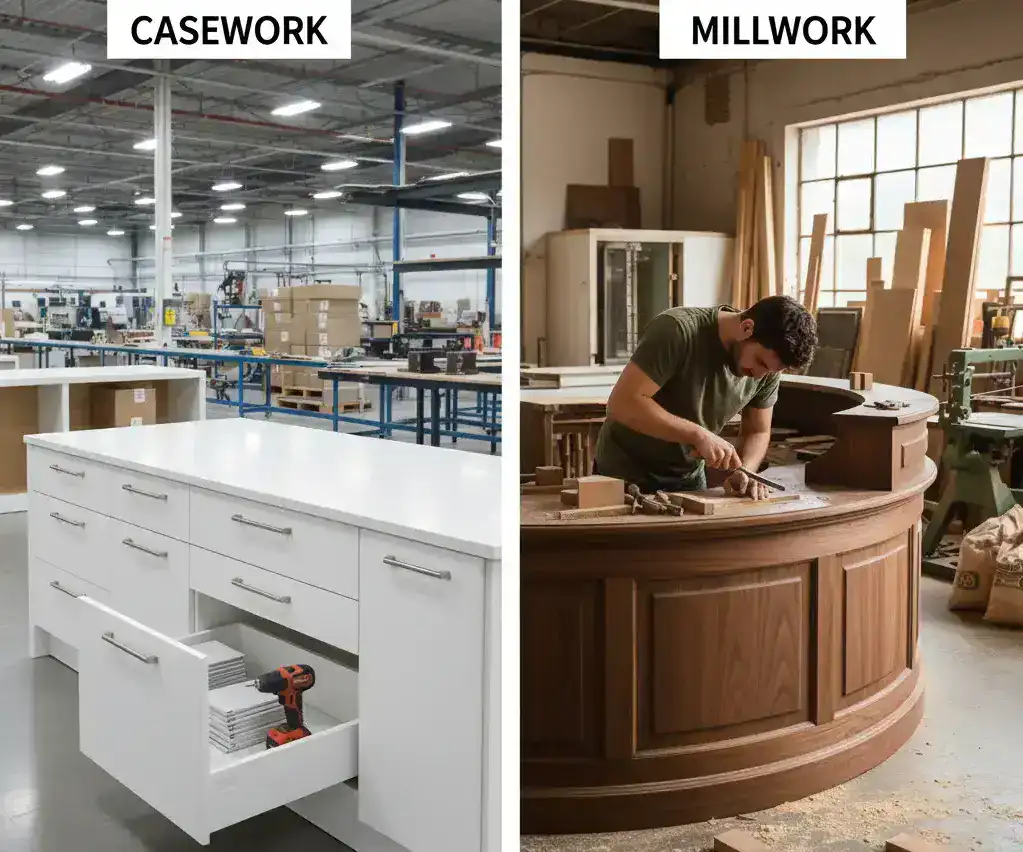
This guide explores Casework vs Millwork to highlight their differences. It is common that almost every contractor faces challenges in terms of budget and timelines. So, one main area that impacts these factors is the selection between casework and millwork. If your choice is wrong, then it will lead you to delays and unsatisfied clients. However, millwork is built specifically to fit a unique space. Casework is pre-made or in box-shaped units. So, it is better to understand them and make the right decisions for your projects.
Contractors and building owners are mostly confused between them. They have to consider various factors, like budget, design, etc. So, to mitigate this confusion, they rely on expert construction cost estimation that provides them a clear picture of everything from budget to design. Stick to this guide and explore all the features of millwork and casework.
What is Millwork?
Millwork is a special wood item, like fancy trim, custom cabinets, or unique door frames. They are built in a factory for a client.
They are customized according to the client’s needs. It creates a beautiful space that fits exactly in the space and the owner’s taste.
They are common for:
- Crown molding
- Baseboards
- chair rails
- wainscoting
- Frames
- Casings
- Custom cabinets
- Fireplace mantels
- coffered ceilings
- Paneling
- Custom-designed staircases
- handrails
- balustrades
Features of Millwork
Every millwork is designed to meet the needs of the clients. This includes accurate measurements and custom dimensions. Plus, it uses premium hardwoods. They are selected because all of them provide good patterns and beautiful finishing.
Individuals who work on millwork must be experienced. Various techniques are used to get the desired look, such as:
- joinery techniques
- precise cutting
- meticulous finishing to achieve architectural-grade results.
What is Casework?
Casework is done for making simple and box-shaped furniture. It includes kitchen cabinets, bathroom vanities, and others. It is usually made in large numbers using the same size. The main focus is on the functionality. So, the most common usage of casework is in:
- Kitchen Cabinets
- Healthcare Settings
- Office Storage
- Retail Fixtures
Features of Casework
Casework is made in a set. That means in standard sizes and styles. Due to this reason, they are built in bulk, which helps to keep the cost low. The blocks made from casework are very easy to arrange.
To build them, experts use plywood, MDF, or particleboard. Plus, they are also made in the factory and then delivered to the site. This saves plenty of time and budget.
CSI MasterFormat Divisions
It is a must to understand the CSI MasterFormat divisions for proper bidding:
Division 06 – Wood, Plastics, and Composites (Millwork)
Division 06 encompasses custom architectural woodwork, including:
- Rough carpentry and blocking
- Finish carpentry
- Architectural millwork
- Wood doors and trim
- Custom-fabricated components
Division 12 – Furnishings (Casework)
Division 12 includes manufactured casework and modular furniture systems:
- Specialty casework
- Educational casework
- Healthcare casework
- Laboratory casework
- Modular cabinet systems
Detailed Comparison between Millwork vs Casework
1. Production Method
Millwork is fabricated in the shops by a skilled person. They used old methods of woodworking to get the desired look. However, every piece is measured, cut, and then combined for a good finish. The production time is long because of the customized work.
Casework is done in the factories by using computer numerical control machinery. The components are built in large numbers to reduce time and speed up manufacturing.
2. Customization Level
Millwork provides countless customization options. The dimensions, materials, and other things are selected by the client. It can be built for irregular spaces and for unique architectural features.
Casework provides limited customization. The dimensions of the box and building methods follow standard patterns.
3. Material Quality and Selection
Millwork is made from solid hardwoods. Plus, high-quality materials are also used. However, the selection of materials is based on the client’s budget. That is why owners get a Millwork Estimation and design things according to their budget.
Casework uses engineered wood products. Well, the materials of casework are chosen according to the affordability and the looks required by the clients.
4. Cost Considerations
Millwork:
- Higher initial cost due to custom design and fabrication
- Labor-intensive installation requiring skilled carpenters
- Premium material costs
- Longer production timelines
- Greater value addition to the property
- Costs range from $150-500+ per linear foot
Casework:
- Lower cost due to mass production efficiencies
- Faster installation with less specialized labor
- Economical materials and standardized components
- Quick turnaround from order to delivery
- Consistent quality across projects
- Costs range from $100-250 per linear foot
5. Fit and Installation
Millwork is processed to fit the exact measurements of the space. Custom millwork accounts for irregular walls and uneven floors. The installation process requires fitting by experienced carpenters.
Casework is built only for standard dimensions. It just requires filler strips or adjustments to fit imperfect spaces. But, professional installation make sure about proper placements. However, they are easy to modify or replace.
6. Project Timeline
Millwork:
- The design and shop drawing phase takes 2-4 weeks
- Fabrication takes 4-8 weeks
- Installation takes 1-3 weeks
Casework:
- Selection takes 1-2 weeks
- Manufacturing takes 4-6 weeks
- Installation takes 3-7 days for typical projects
Hiring experts is a good option for casework or millwork. They will provide you detailed count of every material required according to your project. Contracts must hire an expert takeoff service and achieve what they desire.
Conclusion
Understanding the differences between Casework vs Millwork helps to make the right decisions. It balances the client’s needs and budget restrictions. Millwork offers countless design options and high-quality looks. On the other hand, casework is affordable with limited design options.