

Residential Projects
- Single-family homes and custom lots
- Multi-family developments
- Residential subdivisions
- Housing developments
- Large residential lots and acreage
- Residential site improvements
Our Trade
SMA Estimating LLC has calculated earthwork volumes for U.S. contractors for over 15 years, and our cut and fill numbers hold up under scrutiny. Stop guessing at your dirt quantities! Get accurate cut, fill, and haul volumes with full cost breakdowns for your residential, commercial, industrial, and civil projects in 24 to 48 hours.
24–48 hour turnaround

Bid-ready in 24 to 48 hours
Earthwork is priced in volume, and volume mistakes never stay small. Miss a few hundred cubic yards on a grading plan and you've changed your truck counts, your compaction quantities, your equipment hours, and the number at the bottom of your bid. Soil is heavy, slow to move, and impossible to bring back once it's hauled off site.
SMA Estimating LLC compares existing and proposed grades across your full site to quantify cut, fill, net balance, and import or export volumes. Every estimate converts between bank, loose, and compacted cubic yards using soil-specific swell and shrink factors, then prices the labor, equipment, hauling, and material at current rates for your project's city and state. You get it back in 24 to 48 hours, formatted to your own templates, cost codes, or CSI divisions.
Our estimators work in earthwork daily, so they read what the drawings don't say out loud: conflicting spot elevations, missing existing contours, and phased grading that overlaps. That's the difference between a takeoff that holds up on site and one that turns into a change order. You get a priced bid line, not a quantity sheet, and you bid more jobs without carrying a full-time estimator. Every figure traces back to a specific drawing, so when your price is questioned, you have the backup ready.
Send your plans today. You get a fixed-price quote back the same day and a bid-ready cut and fill estimate in 24 to 48 hours, or in 8 to 12 hours on rush.
What we takeoff
Whatever your earthwork scope covers, we measure it, price it, and return it bid-ready.
We calculate every cubic yard of material required through detailed quantity takeoffs to reach design grade.
Our takeoff team quantifies the compacted volume needed to bring low areas up to proposed elevations.
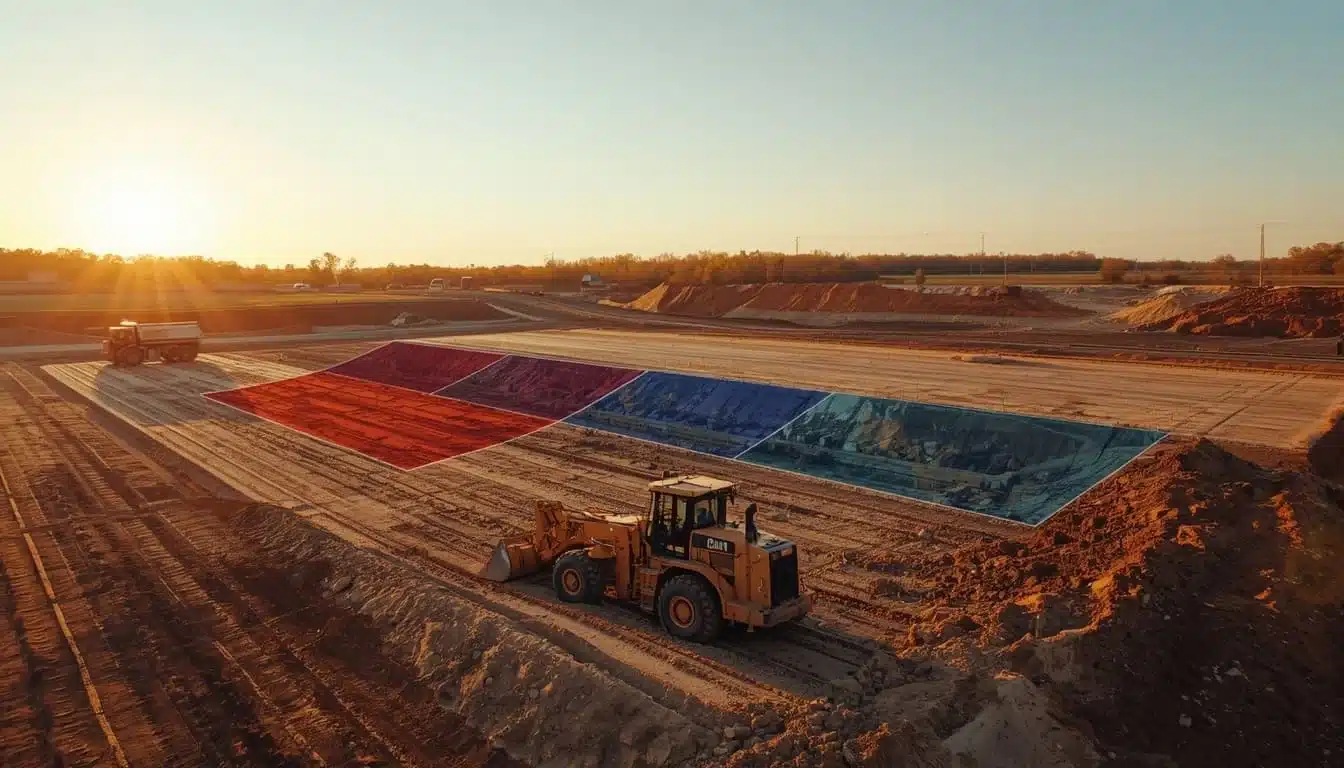
We build existing and proposed surfaces from your drawings and calculate the volume difference across the entire site.
Our estimators price digging, loading, and moving operations against realistic equipment production rates.
We compare total cut against total fill to tell you whether your site balances and by how much it does not.
When the site does not balance, we calculate borrow volumes, export volumes, truckloads, and disposal requirements.
Our takeoff team quantifies structural fill, lift thicknesses, and compaction requirements for embankments and raised pads.
We apply soil-specific shrink and swell factors so your volumes reflect what your crews will actually move, not raw geometric numbers.
We calculate stripping depths, stockpile volumes, and respread quantities as a separate line item, which keeps topsoil out of your mass earthwork balance.
Our civil engineers quantify rock excavation and undercut of unsuitable soils when the geotechnical report identifies them. We price the most expensive risk on the job up front.
We calculate trench volumes, bedding, and backfill tied to your site utilities, covering the full dig as part of sitework estimating rather than mass grading alone.
Our expert cost estimating team converts every quantity into priced labor, equipment, hauling, and material costs at your project's local rates.
When the grading plan is revised mid-bid, we recalculate the affected volumes and pricing so a late addendum stops being a deadline problem for bid management.
What lands in your inbox
You get a complete earthwork package you can bid from, not a single volume number in an email:
Your estimate in both Excel and PDF, with the Excel file fully unlocked so you can edit quantities, adjust rates, and apply your own markup
We also offer custom formats on request, matched to your template, cost codes, or CSI divisions.

Why Earthwork Accuracy Matters
Earthwork is the one trade where a small measurement error does not stay small. Volume depends on depth across an area, so a few inches of misread elevation over a multi-acre site can turn into thousands of cubic yards. Every one of those yards has to be dug, loaded, hauled, placed, and compacted, and each step carries its own cost.
That error falls straight into your soil balance. A site you assumed was balanced may in reality need an imported borrow or paid export, and both are expensive line items that appear after you have already submitted a price. Miscalculated volumes also lead to the wrong equipment on site and the wrong number of truckloads allowed for, which shows up as idle machine hours or a fleet too small to hit schedule.
| Three-inch error across the site | Cost exposure at $12/CY |
|---|---|
| 1 acre | $4,800 |
| 2.5 acres | $12,100 |
| 5 acres | $24,200 |
| 10 acres | $48,400 |
There are compliance costs included in those same numbers. Projects disturbing one acre or more generally need permit coverage under EPA's construction stormwater program, and any excavation and sloping work has to meet OSHA's excavation standard, 29 CFR 1926 Subpart P. Contractors who underestimate their dig routinely underestimate the protective systems that go with it.
This is exactly where our cut and fill estimating services earn their fee. You submit the bid knowing your real excavation volume, your true material balance, and your actual haul cost, which means you can price competitively instead of padding the number and hoping.

Your actual cost moves with project size, plan complexity, number of drawings, scope, how many separate volume calculations are needed, deliverable requirements, and turnaround. We quote a fixed fee after reviewing your plans, with no hourly billing.
| Project Type | Typical Estimate Fee | ||
|---|---|---|---|
| Small residential lot or single pad | $250 – $400 | ||
| Residential subdivision | $400 – $900 | ||
| Commercial site (1 to 5 acres) | $600 – $1,500 | ||
| Industrial or heavy civil (5+ acres) | $1,200 – $2,500 | ||
| Rush service | Add 20 – 30% |
Industry-wide, outsourced construction estimates run roughly $250 to $2,500 per project on a fixed fee, with single-trade takeoffs starting near $250 and full multi-division commercial estimates at the top of that range. For comparison, a full-time in-house estimator costs a contractor roughly $111,000 to $145,000 a year once burden and software licensing are included.
We work backwards from your bid date, so your numbers arrive with time left to review them.
| Project Type / Scope | Typical Turnaround |
| Small residential lot or single pad | 24 hours |
| Residential subdivision or light commercial | 24 to 48 hours |
| Large commercial site (1 to 5 acres) | 2 to 3 business days |
| Industrial or heavy civil (5+ acres) | 3 to 5 business days |
| Complex site, phased or rock excavation | 4 to 6 business days |
| Rush estimate | 8 to 12 hours |
Send your plans as early as you can and tell us the bid date. Complexity matters more than acreage in earthwork, so a tight five-acre site with heavy contour change can take longer than a flat twenty-acre pad. We confirm the exact turnaround when we quote before you commit to anything.
Project Types
We offer comprehensive cut and fill estimating across every project type, from single residential lots to multi-acre industrial sites, so you can bid whatever comes in without turning work away.

Our Client Base

Why contractors stay with us
Every volume calculation is checked by a second estimator against the drawings before delivery. Our quantities land within roughly 2% of the volumes measured from your plans, so the margin you bid is the margin you keep.
Cut and fill is not a side item for us. Our estimators work daily with surface comparisons, soil balance, shrink and swell factors, undercut, and haul volumes, which are the exact places general estimators get earthwork wrong.
Our estimators hold civil and construction engineering degrees, with team credentials including AACE International and ASPE membership. They are trained specifically in earthwork quantity surveying.
We work in AGTEK, Carlson Takeoff, Trimble Business Center, PlanSwift, and Bluebeam Revu, with pricing built on RSMeans data and current regional labor and equipment rates.
You receive labor, equipment, hauling, and material costs separated out with unit pricing and a bid summary. A volume number alone still leaves you doing the hard part yourself.
When the grading plan changes mid-bid, we recalculate the affected volumes and pricing at no additional charge.
Six simple steps
We turn your plans into accurate cut and fill estimates in the following steps:

Send your grading plan, civil drawings, specifications, and geotechnical report if you have one. PDF plan sets are fine, and we confirm scope and price before any work begins.
We read existing and proposed contours, spot elevations, surfaces, and the limits of disturbance, then flag any gap in the drawings as a question rather than an assumption.
Our estimators build the surface comparison and calculate cut and fill volumes across the site, applying shrink and swell factors by soil type so the numbers reflect real placed and hauled quantities.
We compare cuts against fill to determine whether your site balances, and if it does not, we quantify the import or export volume and the truckloads involved.
Labor hours, equipment production rates, hauling, disposal, compaction, and material costs are applied at current rates for your project location.
A second estimator verifies the volumes, unit costs, and totals against the drawings before the finished estimate goes out in your required format.
Questions we get asked
Cut and fill estimating is the process of calculating how much soil must be excavated (cut) and how much must be added and compacted (fill) to bring a site from its existing elevations to design grade. The result is a volume in cubic yards, plus the cost of moving, hauling, and placing that material.
We build existing and proposed digital surfaces from your contours and spot elevations, then calculate the volume difference between them across the whole site. Shrink and swell factors are applied by soil type so the figures match what your crews will actually haul and place.
A balanced site is one where cut volume roughly equals fill volume, so no soil needs to be imported or exported. When the cut exceeds the fill, you pay to haul material off. When the fill exceeds the cut, you pay to bring borrow in. Both are high costs that a volume-only takeoff will miss.
Because earthwork cost depends on volume, not surface area. Two sites of identical square footage can differ enormously in cost if one needs a two-foot cut and the other needs twelve. Cubic yards capture depth, which is where the money is.
Yes. Excavated soil expands when loosened and compacts when placed, and ignoring those factors is one of the most common causes of underestimated fill. We apply factors matched to the soil types identified in your geotech report.
Send your drawings and we will come back the same day with a fixed price and a delivery date. Your bid-ready in 24 to 48 hours.