
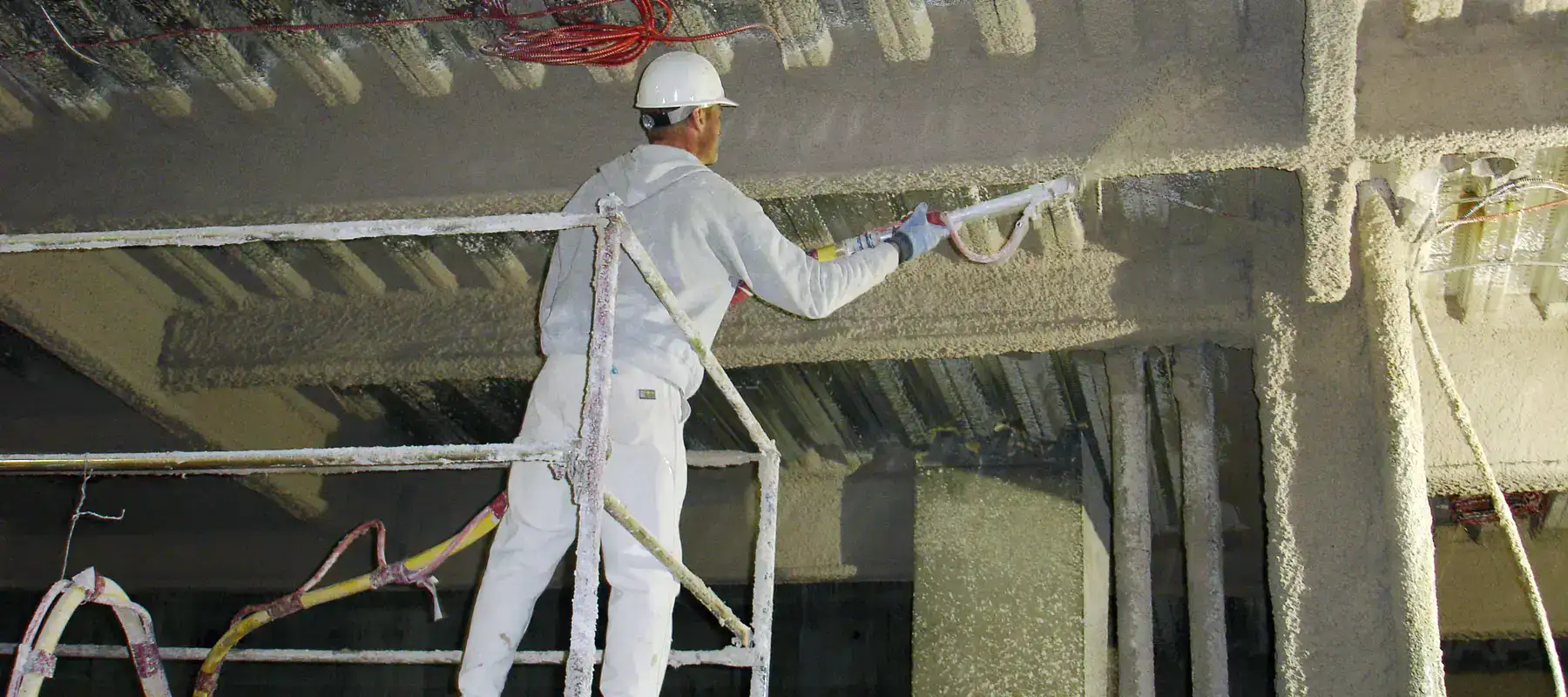
The systems related to fireproofing in construction must be installed according to the exact requirements. Mostly, this component of construction is neglected. But it provides people with more safety for their lives and makes the building stronger. Plus, fireproofing improves the life of materials. These materials are steel, concrete, etc. It slows down the spreading of fire. However, this gives people more time to escape. Firefighters can work more safely.
Contractors and owners need to understand all types of fireproofing so they can build safe buildings. Modern construction demands the installation of smart systems. They have to be according to the local building codes and rules. It is important to choose the right systems, which is possible with the help of a professional.
READ OUR BLOG TO UNDERSTAND ALL ABOUT FIREPROOFING IN CONSTRUCTION AND WHY YOU NEED IT!
Basics of Fireproofing
Fireproofing includes the use of special materials. They are used to stop the spread of fire.
It is important to understand that fireproofing is different from fire-resistant materials. Fire protection strategies consist of two distinct categories:
- Passive Fire Protection consists of fire-resistant coatings. It also includes insulating materials. Their work is to slow the spread. These types of systems work automatically.
- Active Fire Protection is the type of systems that require activation, like alarms that respond to fire accidents.
If you are currently thinking of installing fireproofing in construction projects. It is better to outsource a reliable Construction Estimating Company and install them under budget. The expert estimators recommend the right systems according to your project.
Types of Fireproofing Methods
1. Intumescent Coatings
Intumescent coatings are the latest method. When it touches the heat, it expands to form a char. This helps in reducing the heat. They are of different types:
- Water-based intumescents are a good option because they produce less odor. They are quite affordable compared to others.
- Solvent-based intumescents are more resistant to weather conditions. They dry quickly and provide a smooth finish.
- Epoxy-based intumescents are developed for harsh environments. Especially for chemical facilities. They come in two parts that form a very thick film that insulates the steel member.
These types of fireproofing are beneficial because:
- Thin, paint-like application with an aesthetically pleasing finish
- Can be applied in multiple layers to increase protection duration
- Fewer moisture-related corrosion issues
- Suitable for exposed architectural steel
- Total thicknesses range from 30 mils (>1 mm) to several hundred mils
2. Cementitious Fireproofing
Cementitious coatings have been an old fireproofing method. These types of coatings are made from gypsum, vermiculite, or mineral fiber. This creates a very thick barrier that delays heat transfer to structural steel. They have the following features:
- Cost-effective solution for many applications
- Provides an immediate thermal barrier
- Effective in low-moisture environments
- Thicker application (cement-like appearance)
- May crack, flake, or create spaces where moisture can accumulate
3. Fire-Resistant Boards and Mineral Wool
Fireproofing Boards and Mineral Wool are used to prevent structural elements from reaching high temperatures. However, these systems are useful for providing smooth appearances. It consists of the following features:
- Mineral wool includes glass wool, rock wool, and slag wool, with glass wool enduring up to 1,220°C and R-values of R-2.8 to R-3.5
- Non-combustible and can be used with other fire-resistant insulations
- Available in panels or loose-fill form
4. Firestop Systems
Firestop Systems prevent the spread of fire through gaps in the pipes, cables, etc. These types of systems are important to maintain the integrity of fire-rated walls and floors. Moreover, it is the best method to get expert fireproofing estimating and complete the projects within budget.
When Fireproofing is Required?
International Building Code (IBC) Standards
1. Construction Type
Different building construction types have their own fire-resistance rules. In Type II-B, III-B, and V-B buildings, the IBC Table 601 allows some main structural parts to have no fire rating at all. Even then, some parts still require fireproofing.
2. Supporting Construction Requirements
There is a building code that is often forgotten many times by people. The code (IBC 707.5.1 and 711.2.3) says that designers must find all the fire barriers and fire-rated floors/ceilings in a building. They need to see which structural parts are holding them up. After that, they have to give the same fire rating to those parts.
3. Occupancy Type
Commercial buildings cover the biggest share of the market. These buildings are at high risk of fire. The main reason is that they use heavy electrical equipment, flammable materials, etc. That is why fireproofing must be very strong.
4. Fire Separation Requirements
Buildings require firewalls and fire barriers. They must support the construction to afford the required fire-resistance rating. Fire barriers must be supported by construction that has the same rating as the fire barrier.
Conclusion
Fireproofing in construction includes the right installation according to the building codes and requirements. It is an investment in safety and financial protection. With time, the building codes have become stricter. Moreover, climate change has increased the risk of fire. However, it is better to get expert opinions and install the right thing within budget.