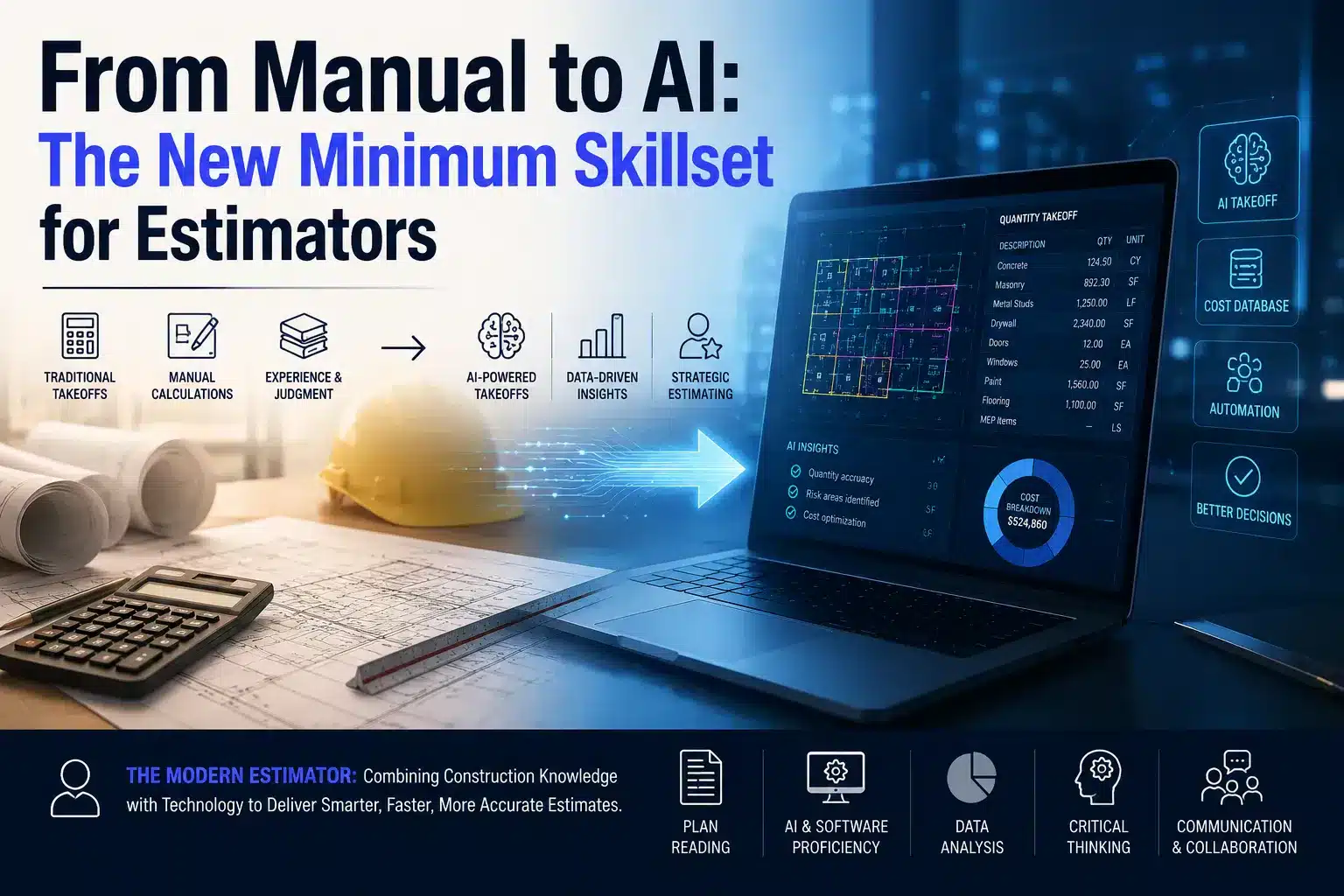
If you are an estimator who worked the old way, like using paper drawings, then you have felt the change already. New AI tools can now count doors, windows, and duct runs in minutes. It is the process that is used to anchor two or three days of your bid cycle. It’s happening on live jobs right now.
The question is what skills actually keep you employed and also well paid. Modern successful construction companies now require enhanced accuracy with speed, which is not possible with manual methods. This article breaks down exactly that: the minimum skill set for estimators currently.
WANT ESTIMATES THAT COMBINE AI SPEED WITH A HUMAN WHO CAN DEFEND EVERY NUMBER? CONSULT EXPERIENCED ESTIMATORS WHO VALIDATE ALL DETAILS.
Why This Matters More Than It Looks
The major cause of budget overruns is inaccurate estimates at the preconstruction stage. This isn’t a technical failure — it’s a judgment problem, and it’s precisely the kind of problem AI can’t fully solve on its own.
Independent testing of leading AI estimating platforms in early 2026 suggests lower error rates than manual takeoffs.
This means that AI reduces specific categories of error. But it introduces a new error: estimators fully trust an AI estimate without knowing how to interrogate it. This is the real issue.
A reliable construction estimating company that combines AI speed with estimators (who can validate and defend a number) can win more bids than those that rely on:
- Slow, fully manual work, or
- AI results that nobody double-checks.
What AI Actually Does Well in Estimating Today
It is important to be clear about where the boundary of AI ends because that is where the “new minimum skillset” begins.
AI is currently strongest at:
Symbol and quantity detection
It scans drawing sets to identify and count doors, windows, fixtures, structural elements, and MEP components automatically.
Speed on repetitive counting
Converts an hours-long process into minutes on straightforward projects.
Cross-checking against historical data
Finds those elements that were present in similar projects but are missing in the current one. This is especially helpful in categories with lots of items, like doors/windows and specialty items.
Pricing lookups
Getting current unit costs from integrated databases instead of relying on a stale spreadsheet tab.
However, AI is not yet reliable at:
- Reading intent behind ambiguous or conflicting drawing notes.
- Pricing risk that isn’t documented anywhere.
- Negotiating bids without damaging the relationship.
- AI chatbots like ChatGPT or Claude are not purpose-built for estimating. They can rely on outdated construction costs or miss important line items entirely. Purpose-built estimating platforms with current cost databases are a different category of tool. Do not get confused between the two.
The 6 Skills That Now Separate Estimators From Software
1. AI Output Validation
Top estimators in 2026 are not the ones who are fast at the takeoff process. They are the ones who verify AI quantity or price. They immediately know whether it’s solid or suspect.
In practice, this looks like:
- Spot-checking AI-detected counts against a sample of sheets manually.
- Knowing which divisions are prone to AI miscounts.
- Recognizing when an AI-suggested unit price is out of step with current local market conditions.
The above points are not optional. This is the checklist that shows whether AI saves your firm money or quietly generates costly errors.
2. Tool Fluency Across the Estimating Stack
No company will hire an estimator who can not open the software on day one. Currently, the estimating stack has layers, and you need working fluency across most of them:
- Takeoff-layer tools for measuring quantities directly from digital drawings
- AI-assisted detection tools for automated symbol recognition
- Cost database integrations
- RSMeans
- Craftsman-style pricing feeds
- Bid management platforms that connect estimating to the rest of preconstruction
3. Risk Pricing the Model Can’t See
AI tools indeed tell you how many linear feet of curtain wall are on a drawing. But it cannot be said that the subcontractor is slow in estimating the last three jobs. Another missing detail can be the site issue that AI can not detect.
In such situations, firsthand project experience becomes irreplaceable. In practice, this looks like maintaining your own informal risk register per project type.
- Logistics constraints
- Historically unreliable trade partners
- Permitting quirks in a given jurisdiction
4. Strategic Negotiation and Subcontractor Vetting
This is one of the hardest skills to look for, precisely because AI has no role in it. Most skills like these are built through repetition of work:
- Vetting sub-bids
- Comparing scope coverage apples-to-apples
- Pushing back on pricing without souring the relationship
5. Cross-Type Estimating Agility
AI is helping experienced estimators learn new project types faster, but many estimators are not giving enough credit for it. Maybe you have spent your career estimating apartment buildings, but then your company won a data center project. AI tools can quickly show you the costs for such a building type. In short, the learning curve becomes less complex.
The real skill isn’t using the AI tool itself. It’s being willing to use it to learn new types of projects.
6. Clear Communication of AI-Assisted Numbers
When you deliver your bid proposals to your clients, you must be able to explain how it was built. Show clients which numbers were your judgments and which were AI-generated.
Reliable construction cost estimating services are those that are able to explain their estimates. This builds credibility.
A Practical Framework: Building Your AI-Estimating Workflow
If your firm is now changing from manual to AI estimating, then here’s a sequence that works in practice:
- Pick one project type to pilot first.
- Run parallel estimates for a set period.
- Set a mandatory human review checkpoint.
- Track the metrics that matter, not just speed.
- Reinvesting saves time deliberately.
Conclusion
The minimum skill set for estimators does not just include how to use AI software. It has changed what the job is really about. It is less about measuring and counting. More about checking the numbers and negotiating. Moreover, one must be able to identify the project risks that AI can not accurately judge. Learn AI tools. But use the time they save you to get better at the things AI can’t do.
FAQs
What’s the most important skill for estimators to learn right now?
The ability to check numbers generated by AI before submitted is the most important skill that must be learned right now.
Can low-cost AI tools handle real estimating work?
Some may cut the overall estimating time for simple projects. The results vary because it depends on the drawing quality and project complexity.