
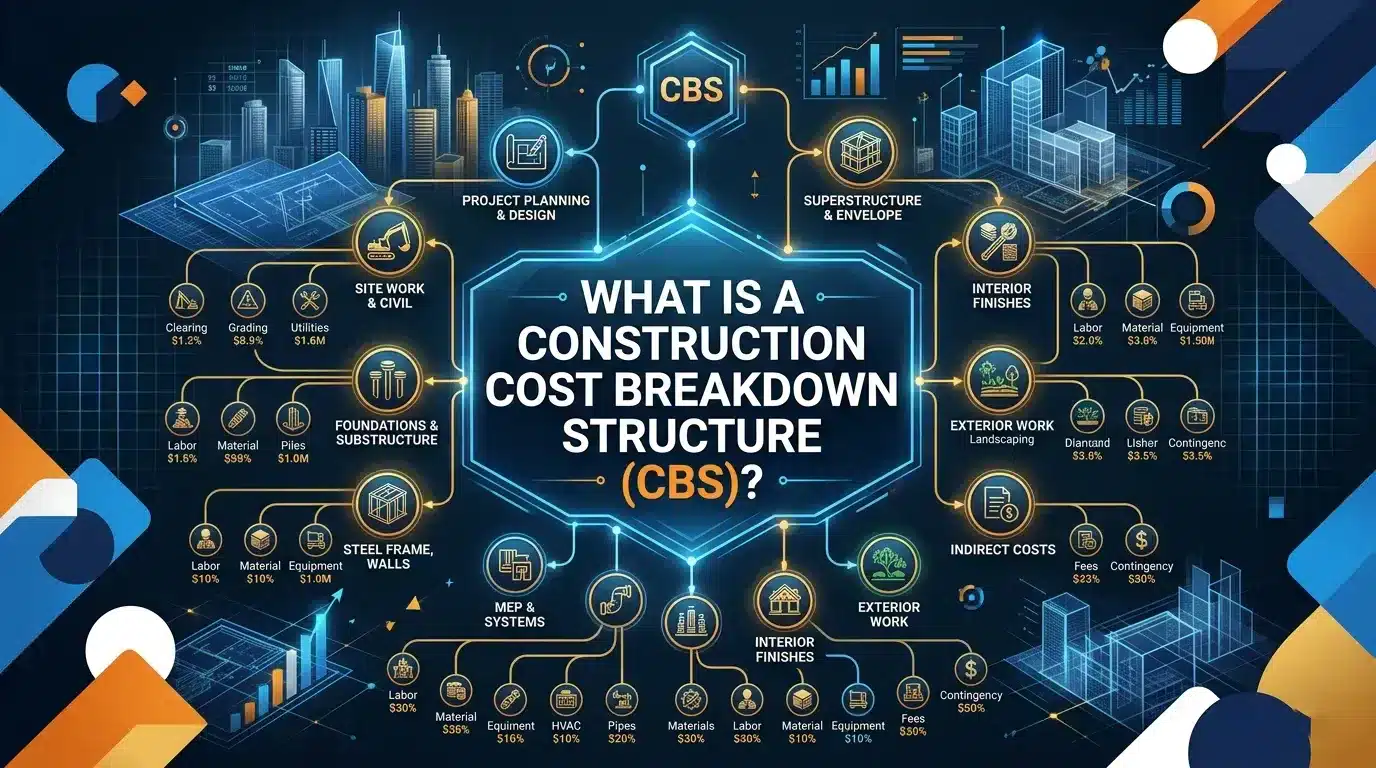
The Construction Cost Breakdown Structure is a protective layer against financial loss. In the current challenging industry, no one can afford to waste money and time. Due to material price fluctuations and labour shortages, the financial law has become quite common. But with the right measures, you can complete your projects under budget and on time. So, keep your focus on the Construction Cost Breakdown Structure because it tells you exactly what it costs to make the construction process happen!
If you are new to this field, then do not take the risk of relying on your guesses. The wisest thing is to outsource the construction cost estimation firm and prevent mistakes. The prices of materials are not predictable!
What Exactly is a Construction CBS?
It is the process that organises every single expense that is connected with the construction project. You can consider it as a tree or a multiple-layer list. It starts with the total project budget and then branches out into the specific categories.
Currently, the CBS is considered one of the most dynamic documents. It is not just created once and finished. It is combined with the cloud-based software to track live spending against the project budget.
The CBS vs. WBS
Most of the beginners get confused between the CBS and the Work Breakdown Structure (WBS). Here is the difference:
WBS focuses on the deliverables and tasks. It answers, “What are we doing?” (e.g., installing the HVAC system).
CBS focuses on the financial resources. It answers, “How much does it cost?” (e.g., $12,000 for units, $4,000 for labor, $1,500 for ductwork).
The CBS usually “inherits” its skeleton from the WBS, ensuring that every task has a corresponding price tag.
Breaking Down the Costs
You need to know that a professional CBS is categorised into four main tiers. It makes sure that no hidden expense slips through the process.
Tier 1: Direct Costs
Direct costs are expenses tied directly to the physical construction.
If you can touch it on the job site, it’s likely a direct cost. It includes hourly wages and other benefits. In 2026, the specialised labour is categorised due to high rates.
The raw materials, like concrete, steel, etc., increase the overall cost. Modern CBS models include 5 to 10% waste expense for materials.
There is also a cost to rent heavy machinery like cranes, etc.
Tier 2: Indirect Costs
These are the expenses that are necessary to run the project! It includes the following expenses:
- Permits and Fees
- Site Management
- Temporary Facilities
- Utilities
Tier 3: Overhead and Profit
This includes the expenses that keep the business running. It includes the following elements:
- Home office rent
- marketing
- legal fees
- accounting services
- Profit Margin
Tier 4: Contingency and Risk
In a world of fluctuating prices, the contingency fund is all you need to save budget.
It must contain 5–15% for known and unknowns.
Steps to Create a Robust CBS
Step 1: Finalize the Project Scope
You cannot price anything that you have not yet defined. For this reason, you need to start reviewing the project plans in detail. Plus, it is also recommended to visit the site. However, every deliverable mentioned in the contract must also be written in the CBS.
Step 2: Assign Cost Codes
If you want to make a CBS useful for software, then every item requires a cost code.
For example:
- 03-000: Concrete
- 03-100: Concrete Formwork
- 03-200: Concrete Reinforcement
This helps track all the expenses across multiple projects. It also helps experts to look at where the business is under or over budget.
Step 3: Quantify and Research
Do not neglect this step because quantity takeoff helps you to calculate the exact amount of material required!
Cost Breakdown Example:
You need to see that if there is 500 yd.³ of concrete, then multiply it by the current market rates.
Step 4: Layer in Indirects and Margins
Once you have the construction cost. You need to add other important expenses, such as:
- site management fees
- overheads
- your desired profit
Step 5: The “Reality Check”
Before finalising anything, you need to compare your CBS with the historical data from similar projects.
If your plumbing estimate is 40% lower than your last three jobs, you likely missed a major line item.
Things to keep in mind!
If you want to make sure that the project remains under budget, then your CBS must be according to the following points.
- Hierarchical Order
- 100% Rule Compliance
- Unique Cost Coding
- Inclusion of Indirects
- Risk-Adjusted Contingency
- Digital Integration
- Historical Benchmarking
Get help from an Estimating Company and keep things in line. Experts are aware of all the possible risks. They deliver accurate estimates to prevent over-budgeting.
Conclusion
The Construction Cost Breakdown Structure is the best guide for financial success. Take time out to convert the project into manageable steps. This helps to make sure that every project member understands the value of the work. It also guarantees that the project remains profitable from the very first step to the end. However, it is recommended to get professional help to manage your expenses. Otherwise, fluctuation of prices can occur due to over-budgeting and delays.