
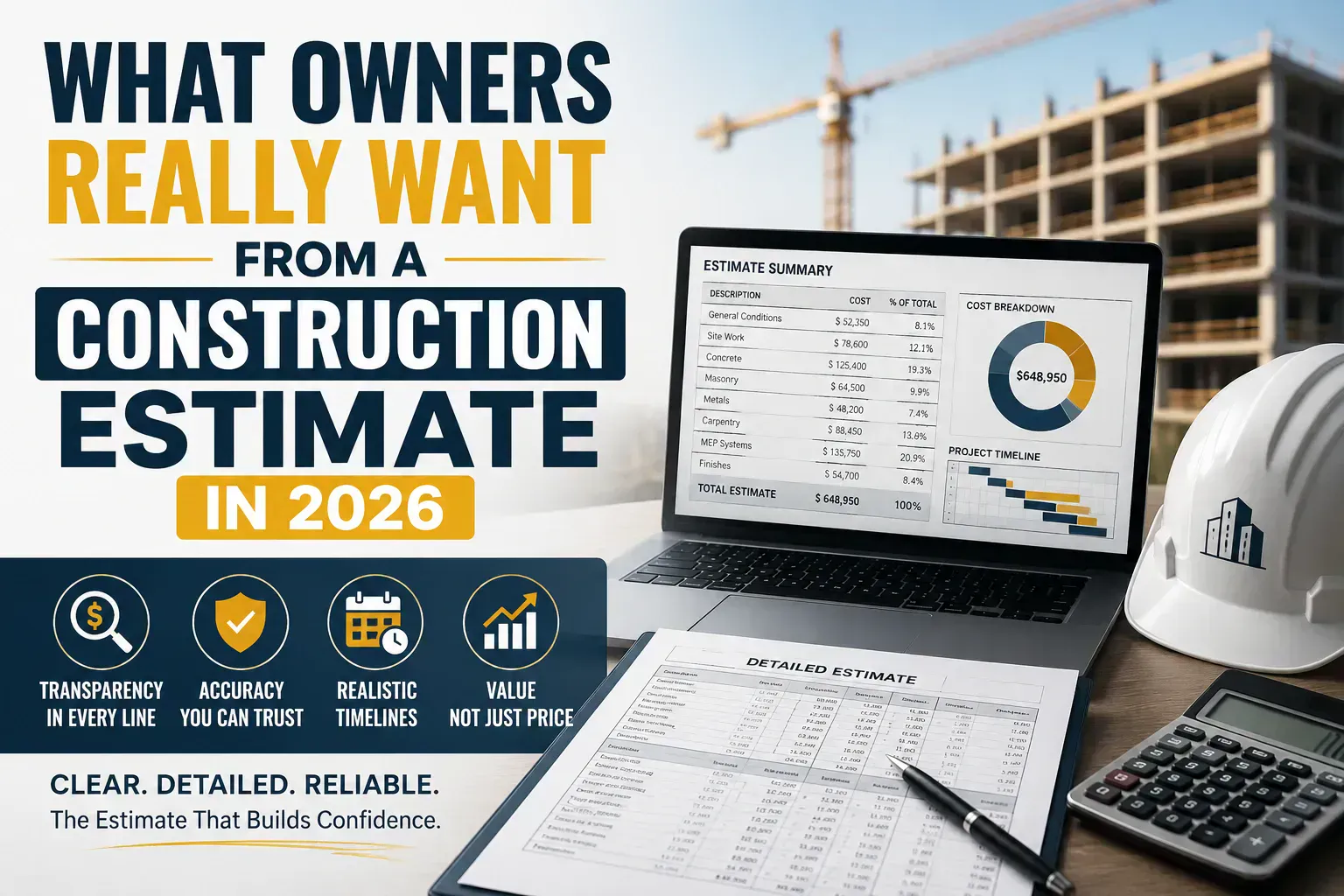
An inaccurate estimate directly involves several risks and results in budget overruns. With the increase in material prices and labour costs, a number that “feels close” is not useful anymore. Now, owners need professional construction estimating services that produce a proposal or document that can actually be defended to a lender.
That gap between a sales-pitch quote and a real budgeting tool is where most construction disputes start. But the good part is that the client clearly understands the line between a trustworthy estimate and a guess. That is why they have more power to demand high-level accuracy.
Why a Bad Estimate Is More Costly Than Ever in 2026
Construction prices are up more than 43% since 2020.
According to the U.S. Bureau of Labor Statistics, even structural metal products are rising over 63%.
Longer-term tariffs are also affecting the overall construction cost by about 8% under the current policy.
Labor is also one of the major barriers that leads to delays. The industry needs about 439,000 additional workers in 2025 and close to 500,000 more in 2026 to meet demand. However, roughly 94% of contractors report difficulty filling open positions.
Fewer qualified workers mean more scheduling risk. There will be more pressure on wages baked into every line item.
In this competitive market, a rough estimate is a big deal. It decides if the project stays on budget or turns into a fight over change orders 3 months later.
When prices move this fast, the owner has an estimate as their real protection. This is the exact reason owners are getting pickier about what’s inside one.
What Owners Actually Want: The Real List
1. A scope that’s specific enough to hold someone to
Unclear line items like “kitchen remodel: $45,000” are not estimates. These are just the guesses with the dollar sign. Owners want to know exactly what is included:
- cabinet brand and grade
- countertop material
- square footage of tile
- Or what happens if they want changes later?
2. Quantities that are actually correct
Every penny in an estimate depends on a quantity takeoff process. It involves:
- Square footage of drywall
- cubic yards of concrete
- linear feet of framing
If the count is not correct, then the pricing built on top of it is wrong, no matter how careful the calculation looks.
Now owners directly ask contractors:
How was this quantity calculated, and what was it checked against?
3. Clear separation of allowances from firm prices.
An allowance is a placeholder. It is not a promise.
Allowances always put more cost risk on the owner. This is because the final price depends on the choices they make after the estimate is approved.
Owners want every allowance flagged. Such as assumed quantity, unit price, delivery, and other details.
4. Overhead, profit, and markup are shown, not buried
A percentage markup isn’t automatically bad, but owners want to see it listed separately. They don’t want it hidden inside material and labor costs where no one can check it.
5. A contingency line that reflects real volatility, not a token gesture
Due to unpredictable price increases in materials, the estimators are now including 5 to 10% contingencies. It is especially for material price changes.
Owners want to know which risks that number is supposed to cover.
6. A payment schedule tied to milestones, not the calendar
This means that the payments should match the real work done. Like “framing finished” or “rough-in passed inspection”. It must not be just random dates.
If an estimate or proposal leaves payment amounts blank, then that is a warning sign.
Don’t just sign it and move on.
7. A documented change-order process
Owners want to know in writing what triggers a change order, how it is estimated, and how it affects the schedule. They want corrections or a rework due to a missed measurement or a mistake against the plans.
The 4-Question Estimate Stress Test
Before signing any proposal, you need to run a four-question estimate test through these:
- Can I trace every dollar to a quantity?
- Are allowances clearly marked and realistic?
- Does the payment schedule match physical progress?
- Is there a documented process for what happens when something changes?
Owners must not repeat mistakes while reviewing estimates
Choosing the lowest bid by default
Why does this happen more often? Because lower cost always attracts. But you need to understand that a low number as compared to competitors means something has been left out. Owners who accept the lowest bid without properly reviewing the estimate often face change orders mid-project.
Treating “estimate,” “quote,” “bid,” and “proposal” as interchangeable
One must understand that a document mentioned as an estimate does not automatically carry the same legal status as a signed contract. You need to confirm what you are actually agreeing to.
Ignoring regional cost variation
Local prices are different for every region according to labor availability, material prices, and many other factors.
Skipping the “what’s not included” conversation
The quickest way to go over budget is to assume permits, site prep, or disposal fees are included when the estimate doesn’t say so either way.
Conclusion
What do owners want from a construction estimate in 2026? A simple answer is that they want a number they can trust. Plan proper queries to ask if you are an owner. It will tell you whether an estimate is a budgeting tool or a sales pitch.
Frequently Asked Questions
Q1: What's the difference between a construction estimate and a construction contract?
An estimate describes expected costs before work begins. A signed contract is what legally binds both parties. It contains detailed information about everything from step one to the last one.
Q2: How much contingency should be built into a 2026 construction estimate?
Many estimators are now building in a 5–10% contingency due to increased material prices. Plus, unforeseen site conditions are also one of the major reasons.