
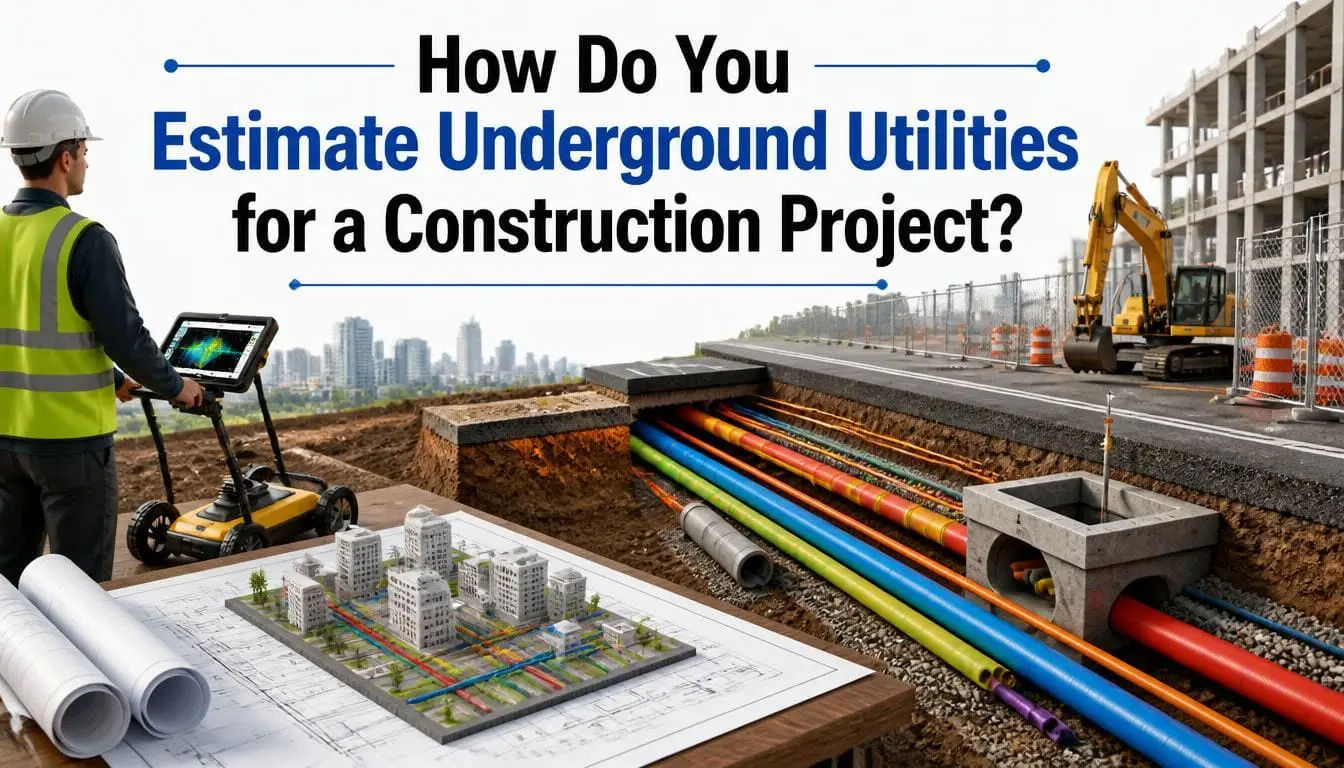
The most common question nowadays is how to estimate underground utilities. Without making this complex, first you need to measure the pipe length, pick the pipe size and material, and calculate trench depth and width. After that, add labor, equipment, and backfill costs. This is how professional site utilities estimating services turn a set of civil drawings into a real number. Skipping any one step or neglecting some factors is the most common reason a bid comes in too low.
You need to stop letting missed fittings or bad soil ruin outputs. Get precise, reliable site utility estimates based on your project specs.
What Does It Mean to Estimate Underground Utilities?
Underground utility estimating means evaluating the exact cost to install pipes below ground. This covers:
- Water lines
- Sewer lines
- Storm drains
- Digging
- Pipe itself
- Labor
This work is harder than it looks. You can’t see the ground until you dig it. That’s why a good underground utility takeoff starts with the plans, not the job site.
What’s the First Step in a Site Utility Estimate?
The first step in a site utility cost estimate is always the takeoff. This means counting and measuring everything on the plan set. Pipe length, pipe size, manholes, catch basins, and fittings are all quantified one by one.
A trench and pipe takeoff should follow the pipe from its starting to its ending point. Keep in mind that every bend and every change in size needs its own line item. If you have missed even one fitting, then be ready to experience budget overruns due to inaccurate estimates.
What a basic underground utility takeoff usually includes:
- Linear feet of pipe, broken out by size and material
- Number of manholes, catch basins, and cleanouts
- Number of fittings, tees, and bends
- Trench length, width, and depth by segment
- Rock excavation, if soil borings show rock is present
How Do You Calculate Trench Size for a Utility Line?
Trench size depends on pipe size and local code. Wider pipes need wider trenches. Deeper pipes need deeper trenches, and deeper trenches often need more safety shoring.
Trench width is usually the pipe’s outside diameter, plus extra room on each side for the crew to work.
Trench depth follows the pipe’s design elevation, called the “invert,” plus room for bedding material underneath the pipe.
This number matters a lot. Too narrow, and the crew can’t work safely. Too wide, and you waste money on extra digging and backfill.
How Is Water, Sewer, and Storm Drain Estimating Different for Each Utility Type?
Water, sewer, and storm drain estimating follows the same basic steps. However, each utility type has its own rules.
- Water lines run under pressure and need thrust blocks at bends.
- Sewer lines use gravity. They need a precise slope, so grade control matters most here.
- Storm drains often use bigger pipes and need bigger structures, like catch basins to handle runoff.
Let us show you a quick comparison of the three main utility types:
| Utility type | Flow method | Key cost driver |
| Water | Pressure | Pipe pressure rating, thrust blocks, valves |
| Sewer | Gravity | Precise slope, manhole spacing, depth |
| Storm drain | Gravity | Pipe size, catch basin count, inlet spacing |
This is one reason expert estimators price each utility type separately. A single “site utility” line item hides too much detail to be accurate.
What Drives Underground Utility Costs the Most?
Underground utility construction costs are affected by high groundwater or unstable soil. Each one changes how the trench is dug and supported. The following are the factors that need to be checked before estimating the project:
| Cost driver | Why it matters |
| Soil type and rock presence | Check geotechnical reports, not just the plans — rock excavation can cost several times more than normal digging. |
| Groundwater level | High water tables often need dewatering equipment, which adds cost and time. |
| Pipe depth | Deeper trenches need more shoring and take longer to dig safely. |
| Pipe material | PVC, ductile iron, and reinforced concrete pipe all carry different material costs. |
| Site access | Tight urban sites cost more to dig than open, easy-access sites. |
Estimators who skip the soil report usually make one of the biggest mistakes. A simple-looking trench can turn into a big job once the crew hits rock or water.
Why Does Accurate Utility Estimating Matter So Much Right Now?
The need for accurate underground utility estimating is growing. The nation’s water systems are aging fast, and the data proves it. The American Society of Civil Engineers gave U.S. drinking water a “C-” and wastewater a “D+” in its 2025 Report Card. Both grades have stayed the same since 2021.
This means more replacement and repair work is coming. Every one of those projects needs an accurate estimate first.
A contractor who can estimate underground utilities correctly has a real edge when this kind of work goes out to bid.
How Do You Avoid Common Mistakes in Underground Utility Estimates?
Take a look at this short checklist to catch common errors:
- Did you check the geotechnical report for rock or water?
- Did you count every fitting, not just straight pipe runs?
- Did you price each utility type (water, sewer, storm) separately?
- Did you confirm trench width against local code, not just habit?
- Did you add a line for traffic control, if the work is in a street?
Utility contractors who follow this repeatable process win more bids and lose less money mid-project. The National Utility Contractors Association represents contractors across the water, sewer, gas, and excavation industries. They support training and safety standards across this exact type of work.
Conclusion
Getting good at underground work means you must never skip a step. When you estimate underground utilities the right way, you follow the same order every time. Takeoff first, trench sizing second, cost drivers third, and a final checklist before the bid goes out. This work isn’t complicated, but it is exact. The contractors who win more bids aren’t the ones with fancy software. They’re the ones who never guess.
Frequently Asked Questions
Q1: What is included in a typical underground utility estimate?
An accurate estimate includes:
Pipe material and length
Trench excavation
Bedding and backfill
Manholes
Catch basins,
Fittings
Labor
Rock excavation
Dewatering
Q2: How do you estimate trench excavation costs?
Follow these steps properly:
1.You multiply trench length by width by depth to get total volume.
2.Price that volume using local excavation rates.
Groundwater and shoring requirements can increase this cost well above a standard soil estimate.
Q3: Why is soil type so important for underground utility estimating?
Soil type changes how fast a crew can dig and what equipment they need. Rock or unstable soil can double or triple excavation costs.
Q4: How often should underground utility cost data be updated?
Pipe and labor prices can shift often, so estimators should check current supplier pricing before every major bid, not rely on numbers from past jobs.
About the Author: Jason holder
