
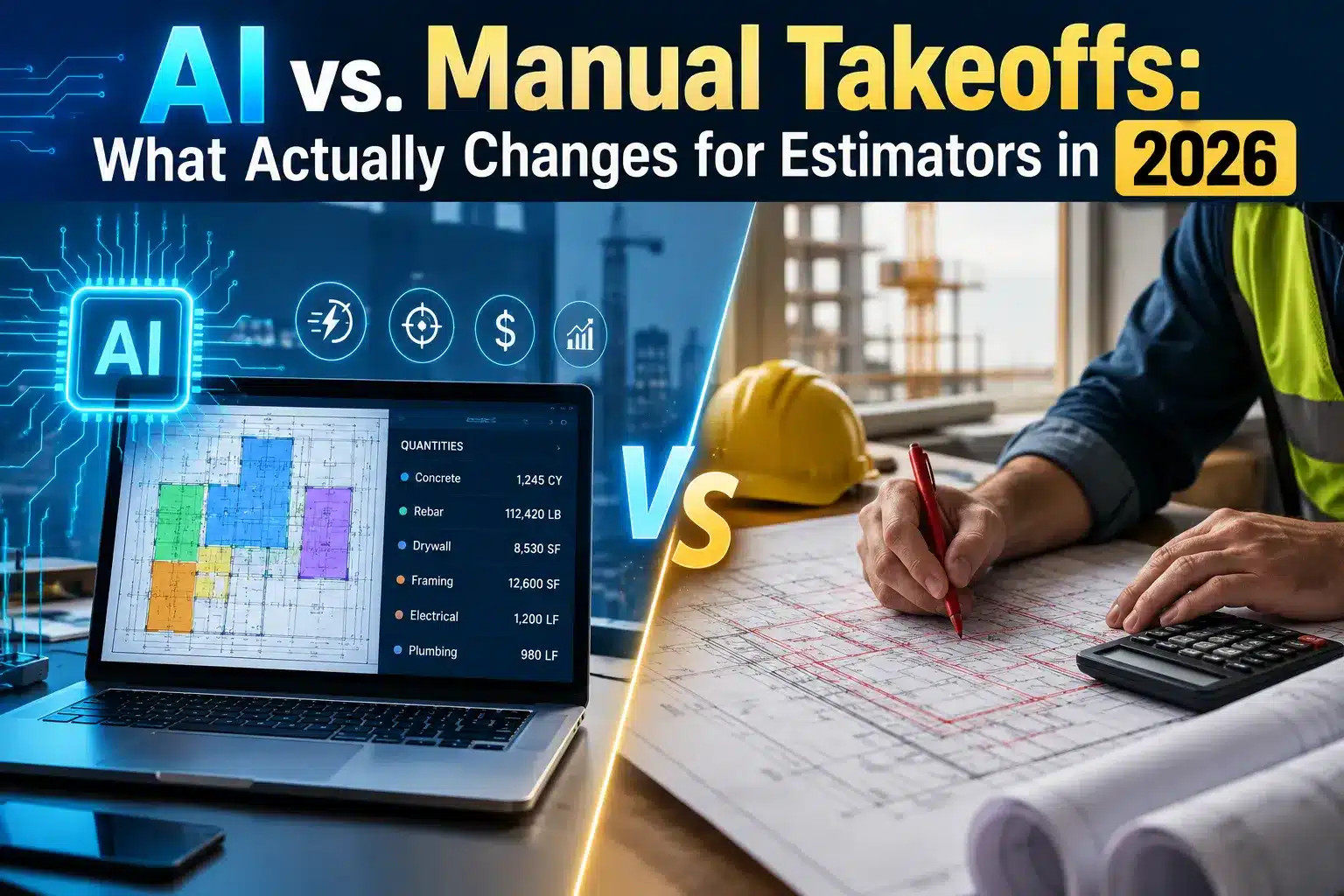
AI takeoff tools are trusted for early budgets and first-pass material counts. They measure and count directly from the digital plan set in minutes. What they still can’t do reliably is read spec sections, an addendum that changes a wall type, a detail that only makes sense to someone who’s built the assembly before. In 2026, estimators are using AI to do the counting and a human to do the judging.
THIS GUIDE BREAKS DOWN EXACTLY WHERE AI HELPS AND WHERE IT FALLS SHORT.
Why This Question Is Suddenly Everywhere
Every leading takeoff platform — Bluebeam, STACK, PlanSwift, ProEst, Togal.AI, Esticom- now comes with a simple auto-measuring feature. Input a PDF, and it will find walls, count doors, measure square footage, and sum up linear feet of pipe, often before you’ve finished your coffee.
That’s led a lot of estimators to ask a fair question: if the software can already measure the drawing, why am I still paying someone to trace it by hand?
The honest answer is that “AI takeoff” isn’t one thing, and knowing which kind you’re using changes what you can actually trust it to do.
What “AI Takeoff” Actually Means Right Now
There are two different things under that one label, and combining them is where most of the problems arise.
Computer-vision measurement tools
The AI is trained to recognize shapes, symbols, and patterns on a drawing — a door swing, a hatch pattern for concrete, a pipe run — and convert them into counts and measurements automatically.
Generative AI
This is a new layer that is built on large language models. It helps to read specifications, addenda, and perform other important tasks. Moreover, the user can get answers to questions like “What’s the fire-rating requirement for this wall type?”
Both matter. But this does not mean that the tool, which is excellent in counting components, is also reliable at telling you whether the door schedule matches the spec section. Now you get the point?
What A Manual Takeoff Actually Involves
A manual takeoff does not always mean that an estimator is using a highlighter and a ruler. Most experts doing this by hand are still working inside digital takeoff software; they’re just doing the measuring and counting themselves rather than letting the software auto-detect it:
- Cross-referencing the drawing against the spec section and catching where they disagree
- Noticing that a detail callout references a keynote that was never actually drawn
- Applying judgment on waste factors, site conditions, and phasing that no drawing shows explicitly
- Catching scope gaps between trades before they turn into change orders
AI vs. Manual Takeoffs: The Direct Comparison
|
Factor |
AI Takeoff Tools |
Manual / Human Takeoff |
|
Speed on clean, well-drafted sheets |
Minutes | Hours |
| Speed on messy, hand-marked, or scanned sheets | Degrades fast, often needs manual correction |
Consistent regardless of drawing quality |
|
Counting repetitive elements (doors, fixtures, studs) |
Very strong | Reliable but slower |
| Reading intent (spec conflicts, scope notes, addenda) | Weak to unreliable |
This is the core skill |
|
Consistency across a revised plan set |
Needs re-verification each revision | Estimator tracks changes as they go |
| Liability if the bid is wrong | Sits with the estimator regardless of the tool used |
Same — but human review catches more before it’s submitted |
| Best use case | First-pass quantities, early budgets, high-volume repetitive counts |
Final bid numbers, anything scope- or risk-sensitive |
Where AI Takeoffs Genuinely Earn Their Place
High-volume repetitive counts
Things like doors, windows, lights, outlets, or wall studs, especially on big apartment building projects, often have hundreds of similar items. This is the best part of AI tools that are designed to handle them well.
Early, rough budgets
When a client wants a rough estimate before drawings are even finished, an AI-assisted takeoff on a conceptual set can produce a range.
First-pass quantities to hand to a human
Estimators no longer need to start from a blank sheet because the AI produces a rough count that the estimator then verifies and builds judgment into.
What Does The Current Estimating Team’s Workflow Look Like
The estimating teams getting the most out of this shift aren’t picking a side. They’re layering the two:
- AI first-pass takeoff. Run the plan set through the measurement tool to get a rough quantity baseline fast.
- Human verification and scope review. A construction estimating company or experienced estimator checks the AI counts against the specs, flags conflicts, and applies waste factors, phasing, and site-condition judgment.
- Final pricing and risk review. Pricing gets applied, and a senior estimator or PM reviews the bid for anything the process might have missed.
- Submission. The number that goes out the door has been touched by both the tool and a person, in that order.
AI makes the counting part faster. But it doesn’t speed up the thinking and decision-making part. The thinking step decides whether you win or lose the contract.
Conclusion
AI takeoff tools are a reliable, useful addition to the estimating process. They reduce the overall time of measuring and counting the project elements. This provides you with free time to review and catch the issues before the bid is due. Treating an AI count as a finished number is the exact situation where a problem arises. If it’s a rough range for a conceptual estimate, an AI-assisted takeoff is usually good enough on its own. If it’s a number that’s going into a signed bid, it needs a human review pass on top of whatever the software produced.