
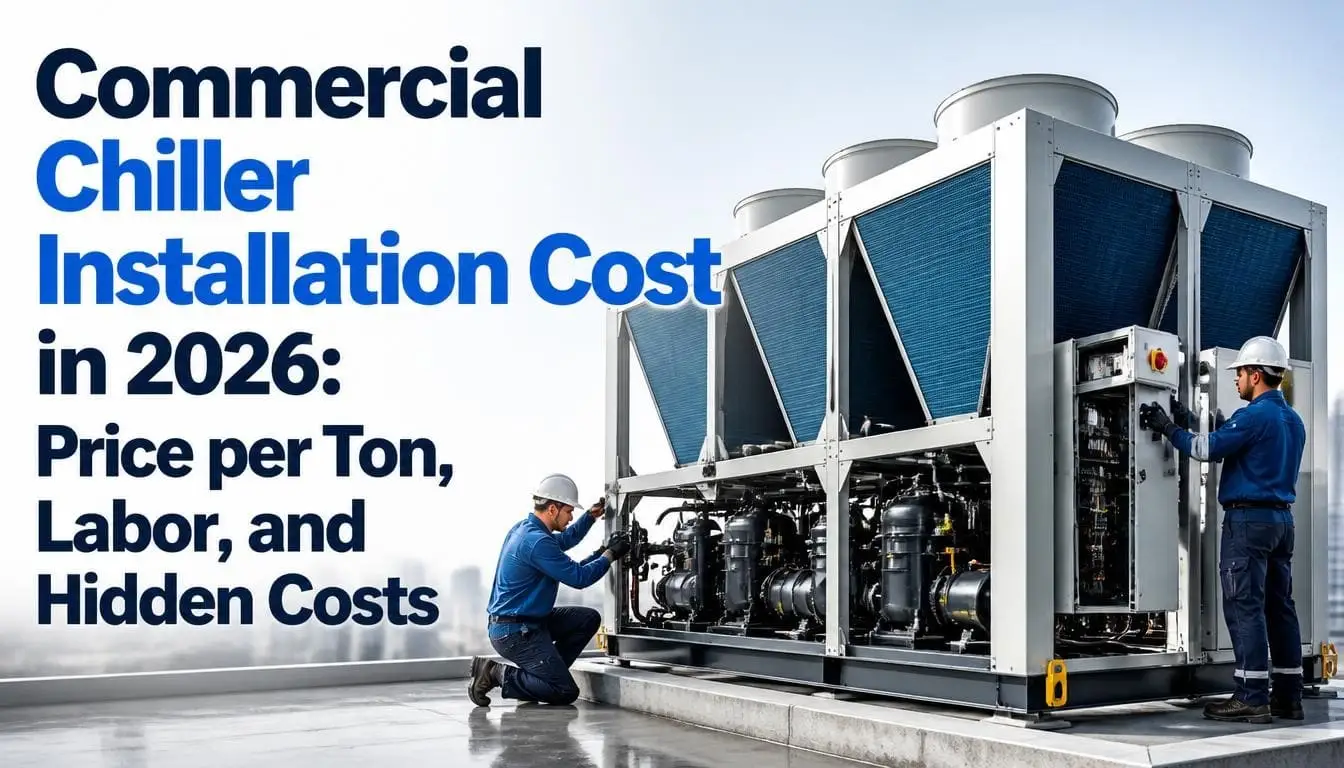
The average chiller installation cost in 2026 runs $1,500 to $4,500 per ton, installed. A 100-ton air-cooled replacement cost ranges between $170,000 and $300,000. A new water-cooled plant with a cooling tower and pumps costs more, often $2,500 to $4,500 per ton. Equipment makes up about half the bill. Labor, rigging, electrical work, and controls make up the rest of the cost of commercial chiller installation.
The rest of this guide breaks down each part of that number, so you can check a quote line by line.
How Much Does a Commercial Chiller Cost per Ton in 2026?
Installed prices of chillers fall between $1,500 and $4,500 per ton for most U.S. commercial jobs. Size, chiller type, and site access increase the cost more than brand does.
Small chillers cost more per ton. A 30-ton job still needs a crane, a permit, an electrician, and startup, so those fixed costs spread over fewer tons.
| Project type | Equipment only (per ton) | Installed (per ton) |
| Under 50 tons, air-cooled scroll | $1,000 to $1,600 | $2,500 to $4,500 |
| 50 to 200 tons, air-cooled screw | $800 to $1,400 | $1,700 to $3,000 |
| 100 to 400 tons, water-cooled, existing tower | $500 to $1,000 | $1,500 to $2,800 |
| New water-cooled plant (tower, pumps, piping) | $500 to 1,000 + tower | $2,500 to $4,500+ |
| 500+ tons, centrifugal replacement | $400 to 800 | $1,200 to $2,500 |
These ranges reflect typical 2026 bids for standard access and mid-efficiency equipment. Magnetic-bearing or high-efficiency VFD chillers add 15% to 30% to the equipment line.
What Is Included in a Chiller Installation Cost?
A complete chiller installation cost covers far more than the machine. A full quote has eight to ten line items, and the equipment is only one of them.
Here is what a typical replacement budget includes:
- Chiller equipment: 40% to 55%
- Mechanical labor and piping: 20% to 30%
- Electrical work: 5% to 10%
- Crane and rigging: 3% to 8%
- Controls and BAS tie-in: 3% to 6%
- Demolition and refrigerant recovery: 2% to 4%
- Permits, engineering, startup: 4% to 8%
- Contingency: 8% to 12%
Missing lines cause most budget overruns. A quote that lists only “chiller supply and install” hides the parts that change the most. Many contractors outsource takeoffs to mechanical estimating services for this reason. A separate estimator prices each line from the drawings, so nothing gets lumped or left out before the bid goes out.
How Much Is Chiller Installation Labor in 2026?
Chiller installation labor costs cover 25% to 40% of the total project. On a 150-ton retrofit, that means 400 to 700 field hours. Labor hours per ton depend on the job:
- Like-for-like swap, easy access: 2 to 3 hours per ton
- Rooftop swap with new piping: 3 to 4 hours per ton
- New plant with tower and pumps: 5 to 8 hours per ton
Wages set the base of this cost. The U.S. Bureau of Labor Statistics lists the 2024 median pay for plumbers, pipefitters, and steamfitters at $62,970 a year, or $30.27 per hour. Contractors bill far above that. After insurance, benefits, trucks, and overhead, the billed rate ranges from $100 to $175 per hour. Union markets and big cities fall at the top of that range.
Overtime is the biggest reason for an increase in labor cost. Hospitals, data centers, and offices often need the swap done at night or over a weekend. That adds a 1.5x to 2x premium on those hours.
Labor is also the hardest line to guess. Crew size, shift limits, and pipe size all change the hours. Smaller firms often lean on HVAC estimating services to build labor hours from real production rates instead of a rough “per ton” guess. A wrong labor number is the quickest way to lose money on a fixed-price bid.
What Hidden Costs Show Up on a Chiller Job?
Hidden costs add 10% to 30% to a chiller project when nobody plans for them. These are the items that most often get missed:
| Hidden cost | Typical range | When it hits |
| Crane and rigging | $8,000 to $50,000+ | Rooftop units, tight streets, road closures |
| Roof steel or dunnage | $10,000 to $60,000 | New unit is heavier or has a different footprint |
| Electrical service upgrade | $15,000 to $100,000 | New chiller needs bigger feeders or a new disconnect |
| Refrigerant recovery and disposal | $3,000 to $15,000 | Every replacement |
| Temporary rental chiller | $8,000 to $20,000 per week | Building can’t go without cooling |
| Pipe flush and water treatment | $3,000 to $12,000 | Old loops with scale or rust |
| Controls and BAS integration | $8,000 to $40,000 | New chiller doesn’t talk to the old system |
| Asbestos in old insulation | $5,000 to $30,000 | Pre-1980 buildings |
| Sound walls or noise fixes | $10,000 to $50,000 | Air-cooled units near homes or offices |
Electrical and structural surprises cause the worst overruns. They usually live in a different trade’s scope, so the mechanical bid doesn’t catch them. On larger jobs, owners and general contractors use MEP estimating services to price mechanical, electrical, and plumbing scope together. That way, the chiller, its power feed, and its water connections are all counted in one budget.
Air-Cooled vs Water-Cooled: Which Costs Less to Install?
Air-cooled chillers cost less to install in most cases. A water-cooled system needs a cooling tower, condenser pumps, condenser piping, and water treatment, and each one adds cost.
| Factor | Air-cooled | Water-cooled |
| Equipment price per ton | Higher | Lower |
| Extra equipment | None | Tower, pumps, treatment |
| Installed price per ton | $1,700 to $3,000 | $2,500 to $4,500 (new plant) |
| Energy use | Higher | 20%–40% lower |
| Water use | None | Constant makeup water |
| Common size | Under 400 tons | 300 tons and up |
The air-cooled vs water-cooled chiller cost answer flips when a good tower already exists. In that case, a water-cooled swap is often the cheaper option, because only the chiller changes.
Over 20 years, energy matters more than install price. Large buildings with long cooling seasons save money with water-cooled plants. Smaller buildings, or sites short on water, do better with air-cooled.
How Much Does a Chiller Replacement Cost Compared with a New Install?
A chiller replacement cost is usually 30% to 50% lower than a brand-new plant of the same size. Pipes, pumps, power, and pads already exist, so the crew mostly exchanges the machine.
Replacements still carry their own costs:
- Removing the old unit: cutting, rigging out, and hauling away
- Refrigerant recovery: required by law before removal
- Matching connections: new units rarely line up with old pipe and conduit
- Downtime planning: temporary cooling if the building can’t shut down
New installs cost more because everything gets built from scratch. That includes the slab or roof steel, a new electrical service, the chilled water loop, and often a tower.
A chiller that is 20 to 25 years old, uses an old refrigerant, or needs a major compressor rebuild is usually a better replacement candidate than a repair candidate.
Why Are Chiller Prices Higher in 2026?
Chiller prices are higher in 2026 because of tariffs on metal and imported parts, plus the shift to new refrigerants. Tariffs hit steel, copper, and aluminum, which make up most of a chiller. In July 2026, new tariffs placed 10% to 12.5% duties on 60 countries, which could raise costs for imported HVAC equipment and components. Manufacturers of motors, valves, and controls have also posted rounds of price increases through the year.
Refrigerant rules add cost too. New comfort-cooling chillers now ship with lower-GWP refrigerants such as R-513A, R-1234ze, or R-454B. Some of these are mildly flammable (A2L), so mechanical rooms may need new leak sensors and ventilation.
Lead times are part of the cost. Larger chillers often take 12 to 30 weeks to arrive. A late order causes a costly rental chiller through the summer.
Final Thoughts
Plan for $1,500 to $4,500 per ton, then add 10% for surprises and hidden costs. That covers most real-world chiller installation cost outcomes in 2026. Start with the chiller price, add labor, rigging, electrical, and controls, and ask every bidder to price the same scope. The cheapest bid is often the one missing the most lines.
Frequently Asked Questions
Q1: How long does a commercial chiller installation take?
The on-site work usually takes 1 to 4 weeks. A simple air-cooled swap finishes in a few days, while a new plant takes several weeks. The bigger delay is often the order itself. Many large chillers take 12 to 30 weeks to ship, so planning should start six months before the cooling season.
Q2: How long does a commercial chiller last?
Most commercial chillers last 20 to 30 years with good care. Air-cooled units sit at the shorter end because they face weather. Water-cooled centrifugal chillers indoors often pass 25 years. Yearly tube cleaning, oil tests, and water treatment are what keep a chiller running that long.
Q3: Is it cheaper to repair or replace an old chiller?
Repair is cheaper when the chiller is under 15 years old and the fix costs less than half of a new unit. Replacement makes more sense for chillers over 20 years old, units using phased-out refrigerants, or machines that need a full compressor rebuild. A new unit also cuts energy bills, which shortens the payback.
Q4: Do I need a permit to install a commercial chiller?
Yes. Almost every U.S. city requires mechanical and electrical permits for a chiller install or replacement. Rooftop jobs often need a structural review, and crane work may need a street-use permit. Permits and engineering usually add 3% to 8% to the project.
About the Author: Jason holder
