
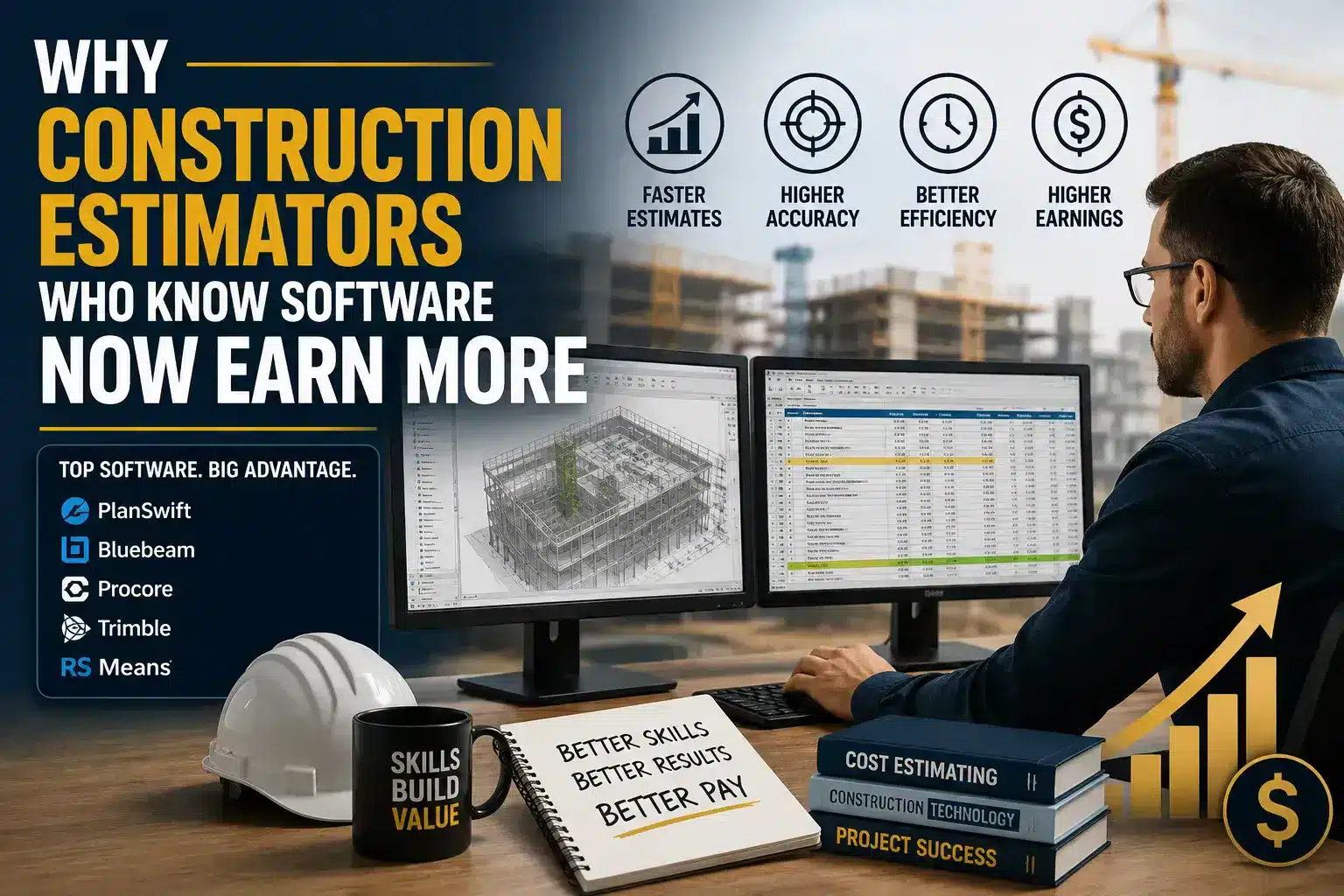
You are working harder than you need to if you are still generating takeoffs by hand. According to recruiters and salary data from the construction industry, there is a pay gap between estimators who use digital takeoff and estimating software and those who don’t. It’s showing up in 2026 salary guides as a 5–15% gap tied directly to technology skill.
What’s the actual pay gap, and why does it exist?
Estimators who are pro in digital takeoff out-earn peers who rely on manual processes. This gap exists because software skills enhance the role of an estimator. It changes the results of what an estimator can produce in a day:
- The first thing is Speed. Modern takeoff tools let one estimator bid more work as compared to manual methods.
- The second thing is accuracy. Mistakes in the quantities are caught at the takeoff stage. It prevents all future losses.
- The third thing is the win rate. Firms increasingly track bid-to-win ratio as a hard metric, and estimators who can demonstrate a strong ratio have real negotiating leverage.
A senior estimator who can run a 3D takeoff in STACK or ProEst. Also, link it to a live cost database. Complete the commercial bid in two days instead of five. On the other hand, a manual estimator on the same team is still tracing linear footage by hand.
Why this matters now, not eventually
Two years ago, estimating software experience was an additional skill on a resume.
In 2026, it is a baseline requirement for all project sizes. The companies are not paying the premium out of generosity. They are paying for their desired outcomes:
- faster bid turnaround
- fewer pricing errors
- to chase more work
There is also a labor-supply angle. The industry continues to report difficulty hiring experienced estimating and senior placements. It often takes 90-plus days to fill.
This difficulty in finding gives modern estimators outsized leverage.
Most importantly, if they are specialized in trades like MEP, heavy civil, data center, and industrial work. It demands technical complexity, which is why the pay is higher.
Which software skills actually move the needle?
1. Digital takeoff platforms
Tools like STACK, PlanSwift, and Bluebeam Revu let estimators measure quantities directly from digital drawings.
STACK and PlanSwift are two of the best construction estimating software that help in evaluating specialty trades. Plus, commercial estimators use them for dedicated takeoff work.
Bluebeam is the standard for PDF markup and document collaboration.
2. Integrated estimating and preconstruction platforms
ProEst and Procore combine four things in one platform:
- takeoff
- cost databases
- bid management
- reporting
The advantage is that a won estimate flows directly into a project budget without re-evaluation of numbers into a separate system.
3. AI-assisted takeoff and estimating tools
Latest AI takeoff and estimating tools cut manual measurement time and let a single estimator handle multiple bids.
Tools like Togal.AI and similar platforms help to save 15–20 hours per week on takeoff-heavy work. But that does not mean to consider them a final decision.
Expert estimators must check every detail carefully. However, the estimators positioned to earn the most aren’t necessarily the fastest at producing a number. They are the ones who can look at an AI takeoff and judge whether it’s right.
How to actually close the gap: a practical framework
If you are going to hire an estimator, here’s a realistic path to capturing the premium rather than just reading about it.
- Pick one takeoff tool and get fluent, not just familiar.
- Learn the data layer, not just the interface.
- Track and document your bid-to-win ratio.
- Build validation skill alongside speed skill.
- Consider a sector specialization.
Common mistakes that keep estimators underpaid
- Listing software on a resume without proof. Saying “Proficient in ProEst” is not enough. Add a real example. It can be project size or how accurate you were.
- Do not assume that all software is the same. If a company uses Procore for project management, they won’t care that you know STACK. They want estimating tools that work with what they already have.
- Thinking AI tools have replaced the need for judgment. Companies are specifically hiring for the ability to validate AI output, not only to operate the tool. Depending completely on the automated takeoffs is not right.
- Ignoring soft skills if you need higher pay. Estimators who can present to clients and lead value engineering talks are now paid like preconstruction managers. Only software skills will not give you a higher salary.
Final Thoughts
The pay gap between software-fluent and manual estimators is a real shift in what firms need from the role. They need faster turnaround, fewer errors, and the judgment to validate AI tools. The best way to fill this gap is to learn advanced software and track outcomes you can quote in a negotiation. Work on validation skills. It will keep you valuable as AI takes over more of the mechanical work.