
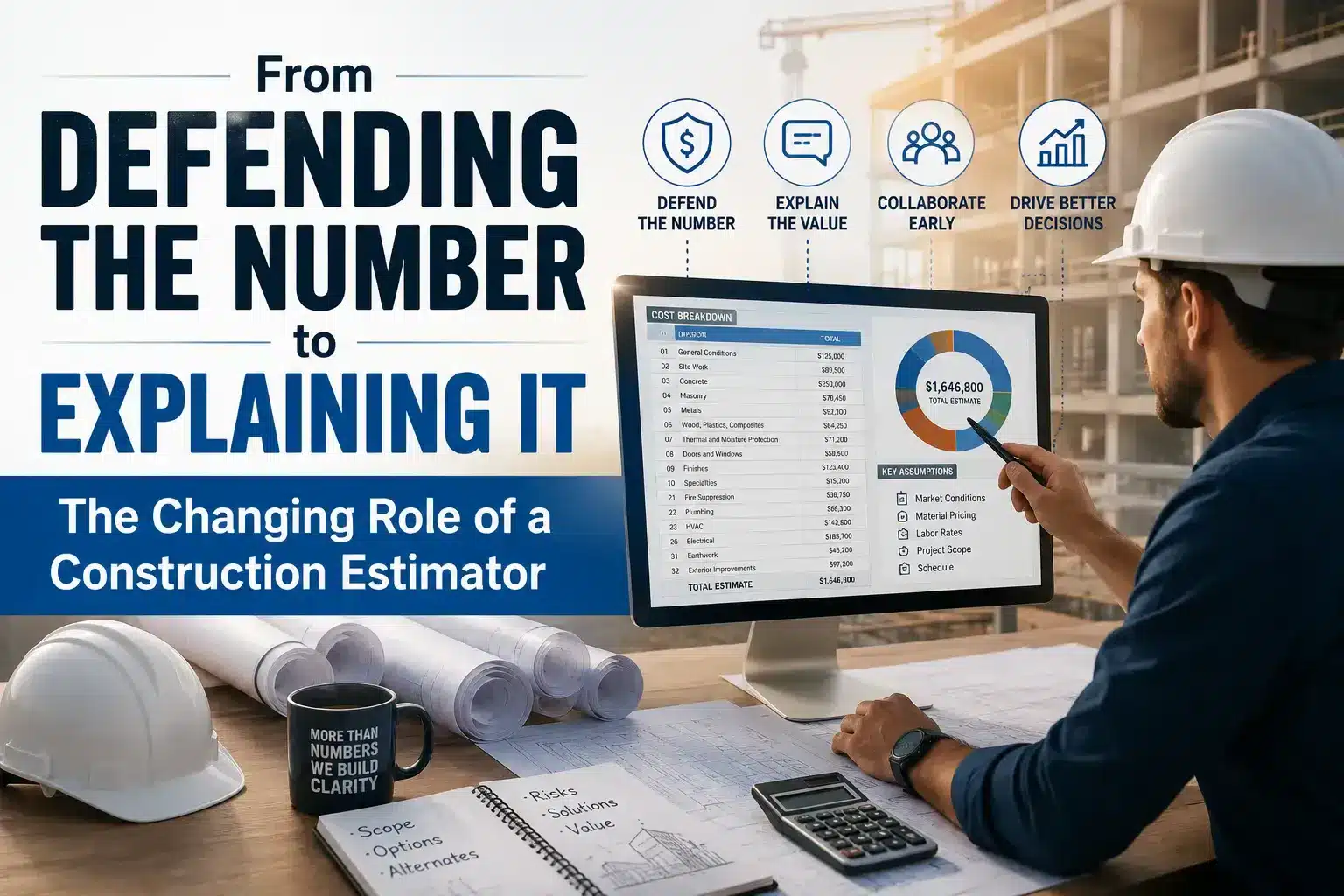
For most of the profession’s history, the role of a construction estimator was producing a defensible number. In 2026, with AI-assisted takeoffs and live pricing tools, the role of estimators has changed from producing the number to explaining it. They have to explain to the client or a general contractor why a figure looks the way it does and what could change it. The cost evaluators who are struggling right now are the ones still positioning themselves as human calculators. The ones pulling ahead are positioning themselves as interpreters.
Why The Job Is Actually Changing
According to the U.S. Bureau of Labor Statistics’ Occupational Outlook Handbook, the number of cost estimator jobs is expected to go down over the next 10 years. What is the reason? The agency says that the construction cost estimating software is making workers more productive — so companies need fewer estimators to do the same amount of work. That is not a small change; it is the government’s own job data confirming that the basic, repetitive part of this job is now being automated on a large scale.
But the same BLS data notes something equally important: roughly 16,900 openings for cost estimators are still projected every year. This is affected by the need to replace people who move into other roles or retire.
Fewer people are needed just to produce the numbers. But the people who stay hold more importance for what they do with those numbers after the software creates them.
What “Defending the Number” Used to Look Like
For a long time, the value of an estimator was analyzed by who could explain every step in detail:
- Justifying a unit cost by walking through the labor productivity assumption behind it
- Defending a contingency percentage against a client who thought it was padding
- Standing behind a number in a value-engineering meeting when a GC pushed back on price
- Being the final word on “is this number right,” because the estimator did the math themselves
What “Explaining the Number” Looks Like Now
Numbers and prices now come from advanced AI takeoff tools and live pricing feeds; simply saying “I calculated it, trust me” isn’t good enough anymore. Mostly, the estimator didn’t actually do the calculation by hand; the software did.
What replaces that authority is a different construction estimator skill: being able to explain the reasoning behind a number, even when the number itself came from a tool.
- Explaining why a line item moved between two versions of a bid, tracing it back to a material price shift or a scope change, not just a spreadsheet cell
- Translating a flagged discrepancy between drawings and specs into a plain-language risk explanation for a client
- Walking a GC through which parts of a bid are firm and which are contingent on a volatile material or an unresolved design detail
- Framing contingency and risk in terms a non-estimator can actually act on, instead of just a percentage on a summary page
Defending vs. Explaining: The Direct Comparison
|
Factor |
Defending the Number (traditional role) |
Explaining the Number (2026 role) |
|
Primary skill |
Calculation accuracy and recall | Communication and synthesis |
|
Where the number comes from |
Estimator’s own manual work | Often AI-assisted, human-verified |
|
What a client actually wants to hear |
“Trust my math” | “Here’s why, and here’s the risk” |
| Value under scrutiny | Can I reproduce this calculation? |
Can I explain what’s driving this and what could change it? |
| Vulnerability to automation | High — pure calculation is increasingly automatable |
Lower — judgment and communication are harder to automate |
| Career leverage in 2026 | Shrinking |
Growing |
One pattern is common: the estimators getting promoted into senior construction estimator roles aren’t always the fastest at doing takeoffs. Instead, they’re the ones that clients or general contractors actually trust to clearly explain a number to them.
The Workflow Estimating Teams Are Actually Using in 2026
- Let the tools generate the raw number. AI in construction estimating and live pricing feeds handle the bulk of the mechanical calculation.
- Verify and annotate, don’t just accept. The estimator checks the output, corrects errors, and — critically — notes why specific numbers look the way they do.
- Build a plain-language narrative around the bid. Instead of a wall of line items, the estimator prepares a short explanation of what is affecting the total.
- Present the number with the reasoning attached. In client and GC meetings, the estimator leads with the explanation, not just the total, and treats questions as an opportunity to demonstrate judgment rather than a challenge to fend off.
- Document the “why” for future reference. So if the number is questioned later — in a claim, an audit, or a change order dispute — the reasoning trail already exists.
A Quick Decision Framework
Next time you are preparing to deliver a project, ask:
If someone challenges this figure? Am I ready to explain the reasoning behind it?
If you can provide a detailed explanation behind the estimated number and the risk involved, you’re doing the part of the job that’s becoming more valuable, not less.
CURIOUS HOW AI IS RESHAPING THE REST OF THE ESTIMATING PROCESS? READ OUR GUIDE ON AI VS. MANUAL TAKEOFFS TO ENHANCE YOUR WORKFLOWS
Conclusion
The estimators who feel affected by AI are usually the ones who still measure their value by how fast or accurately they can produce a number. But modern estimators understand and explain the numbers. They know how to defend the assumptions and translating it into something a client or GC can actually act on. If you are going to start a journey to become an estimator. It is highly recommended to learn and practice new methods to understand the modern role of a construction estimator.
Frequently Asked Questions
Q1: Is AI making the estimator role obsolete?
No, but it is changing which part of the job carries the most value. According to BLS projections, the overall number of jobs for cost estimators is expected to reduce as software improves productivity. This does not mean that the profession is disappearing. The skills in demand are shifting from producing calculations to interpreting and communicating them.
Q2: What skills should estimators focus on developing now?
Communication, risk framing, and the ability to explain the reasoning behind a number, not just recalculate it, are becoming the differentiating skills.